
Documentary location photography for Business Improvement Districts UK
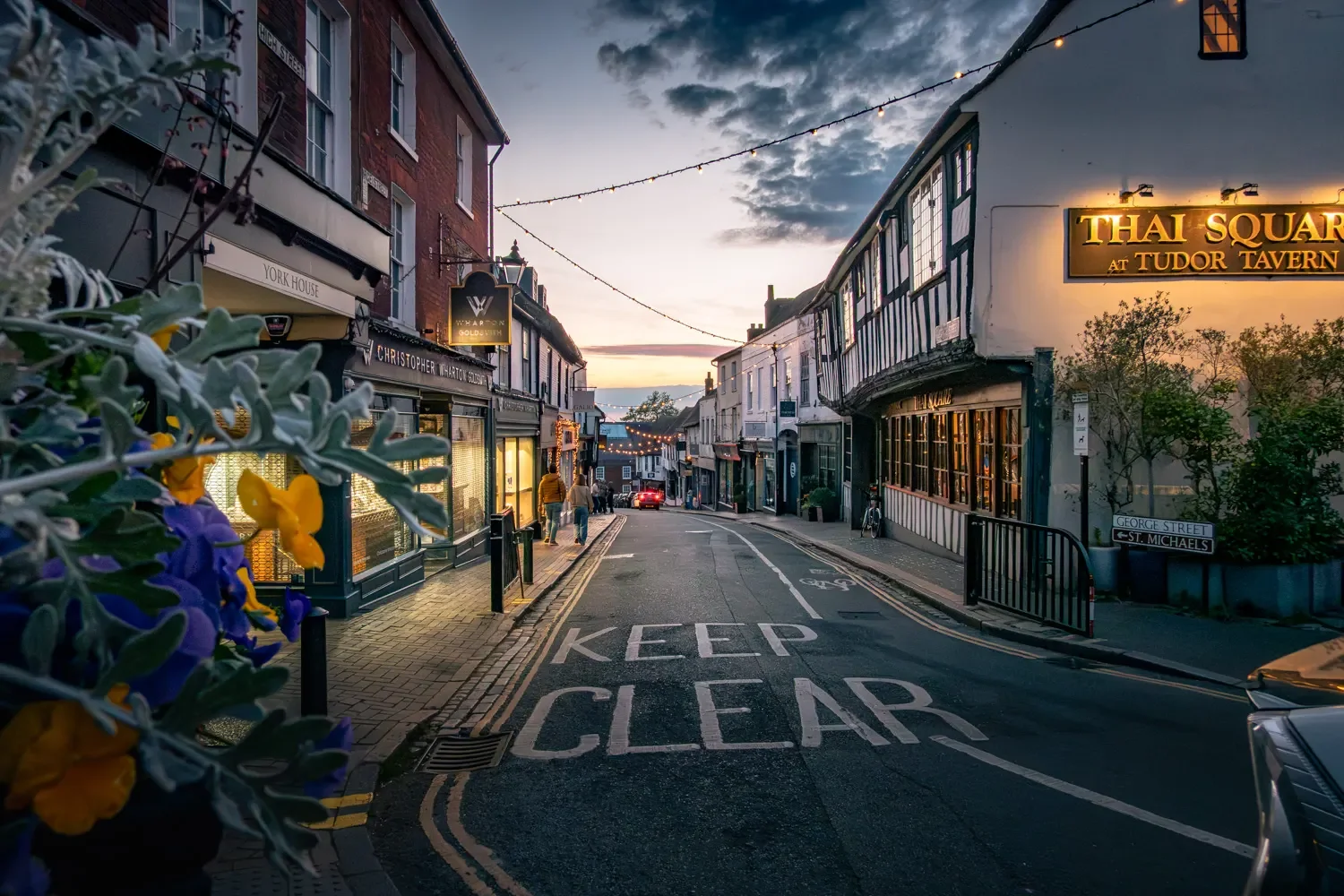
The George Street at dusk – fairy lights, warm shopfronts, and the BID's flower containers all in one frame. This was the shot I came back for.
When St Albans City Centre BID approached me to document the town on their behalf, the brief was clear: they needed a professional image library that showcased everything they do – the flowers, the lighting, the murals, the benches, the street life, and they needed it ready for their Ballot submission in October 2026, when BID levy payers vote on whether to renew their mandate for a third five-year term.
This wasn’t a one-afternoon job. It was a structured commission with seven distinct subjects, multiple locations across the city centre, and images needed in both print and digital formats. Here’s how I approached it.
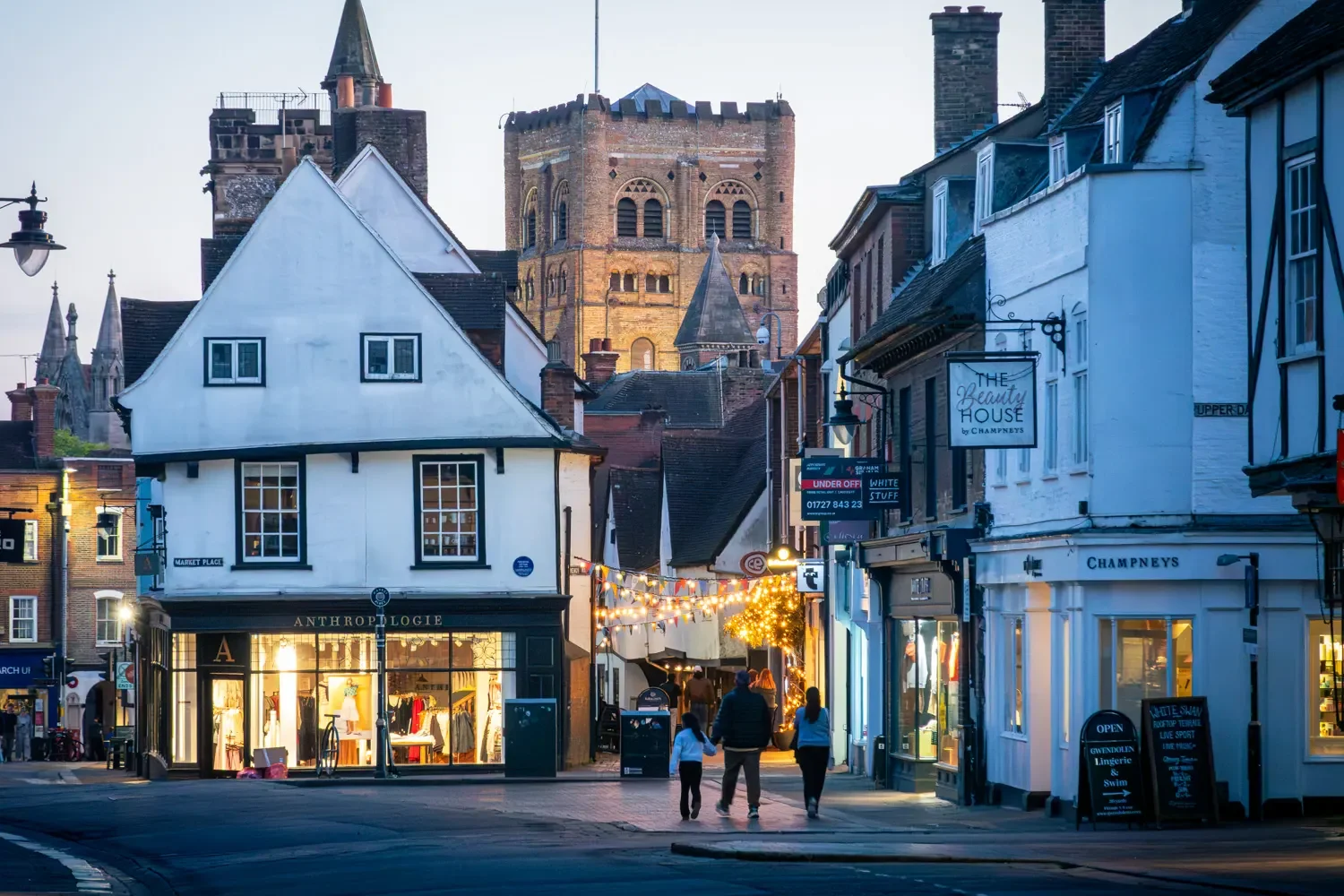
The cathedral at blue hour – one of St Albans most iconic views, and one of the standout shots from the commission.
The brief
St Albans BID promotes the city to local, national and international visitors. For the Ballot submission, they needed images that didn’t just document what’s there, they needed images that made the case for why the BID’s work matters.
As the brief put it: a good image of an enhancement outside a business premises is a sales pitch to that business for the BID’s impact. That framing shaped how I shot everything.
The seven subjects were:
Flower containers and barrier baskets across St Peter’s Street, Chequer Street, Holywell Hill, High Street, London Road, Hatfield Road, Catherine Street, Drovers Way, and the top of George Street
Lamppost banners including the new Blue Plaques series installed in late April
Murals at Drovers Way and Waddington Road
Seating and benches in front of and alongside the Museum and Gallery
Evening festoon lights on Waddington Road, French Row, and George Street
General street scenes showing the city as a busy, welcoming destination
People shopping, at outdoor café tables, and going about their day
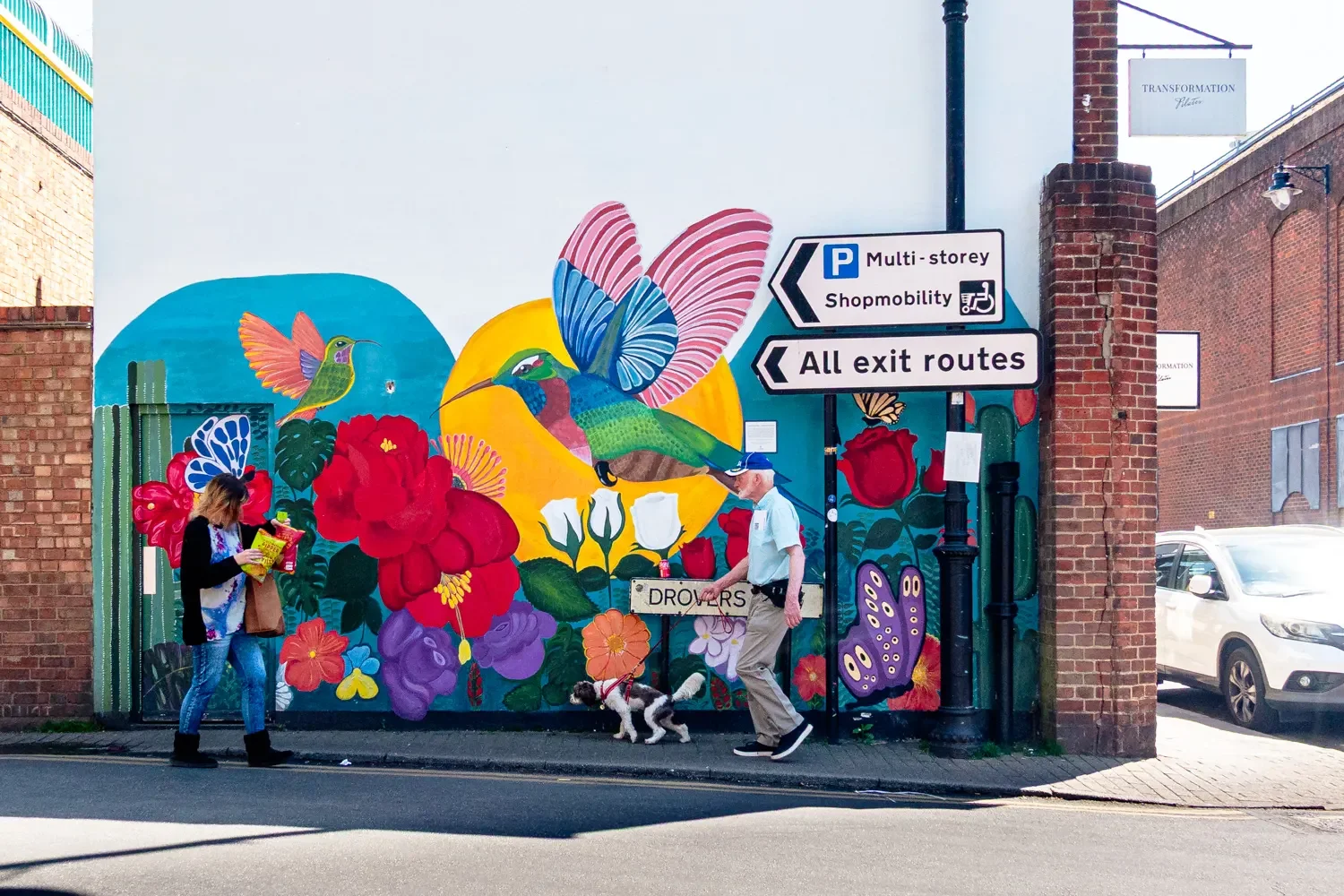
One of St Albans' most striking murals, near Drovers Way.
The approach
I had the luxury of time. The deadline was end of May, which gave me room to work across multiple sessions and come back repeatedly if conditions weren’t right. In total I shot five sessions, a mix of daytime and evening, between late April and May.
The weather helped. Once it cleared at the end of April, I had consistent sunshine and blue skies, which made a significant difference to the flower containers and street scenes in particular.
The evening sessions required more patience. The festoon lights don’t come on until around 7pm, and the sky needs to reach that specific shade of deep blue, dark enough to create contrast with the lights, but not so dark it loses all detail. That window is short. I shot George Street and French Row several times across different evenings to get the timing right, waiting for a couple of the shop fronts to be lit so their orange glow could warm up the street.
Throughout the project, my aim was to capture each subject with people nearby or interacting with it. An empty planter on an empty street tells you nothing about scale or impact. A barrier basket in the foreground with shoppers behind it, or a family walking past a mural, that’s the image that works in a submission document. It took patience. There were sessions where I arrived at the right spot at the wrong moment, too quiet, or too crowded to see the subject clearly, and simply had to come back.
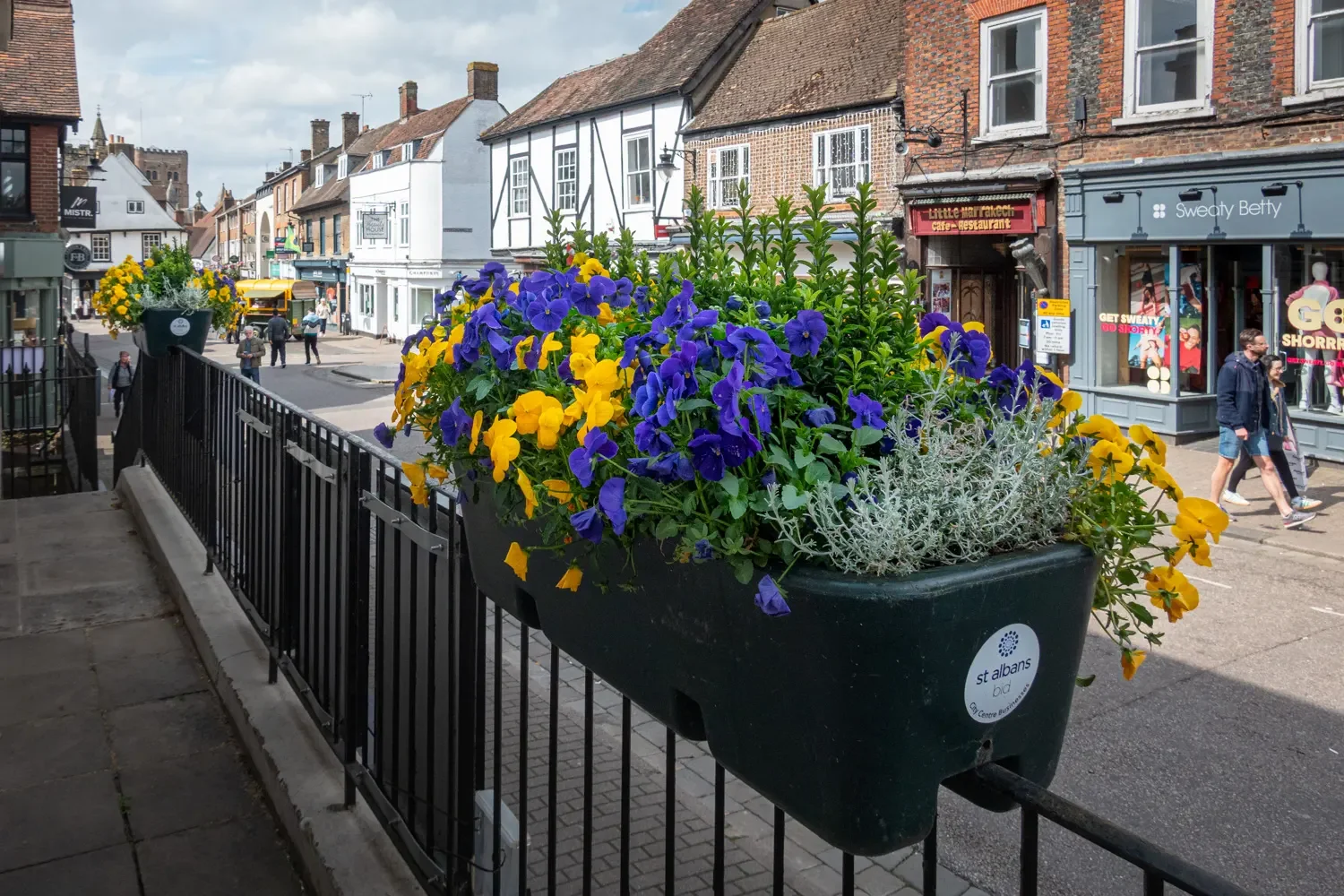
The BID’s flower containers line the high street – 57 documented across the commission.

A heritage blue plaque at 23 George Street, framed by bougainvillea – history and horticulture in one shot.
The result
The final delivery was 257 professionally post-processed images across all seven subjects, exported at full resolution for print and web use:
Flower containers – 57 images
Generic St Albans town centre – 88 images
Evening lights – 25 images
Blue plaque signs – 25 images
Banners – 25 images
Museum benches – 9 images
Murals – 8 images
Every image was colour-graded and exported in formats suitable for magazines, leaflets, social media, and web, ready to use from day one.
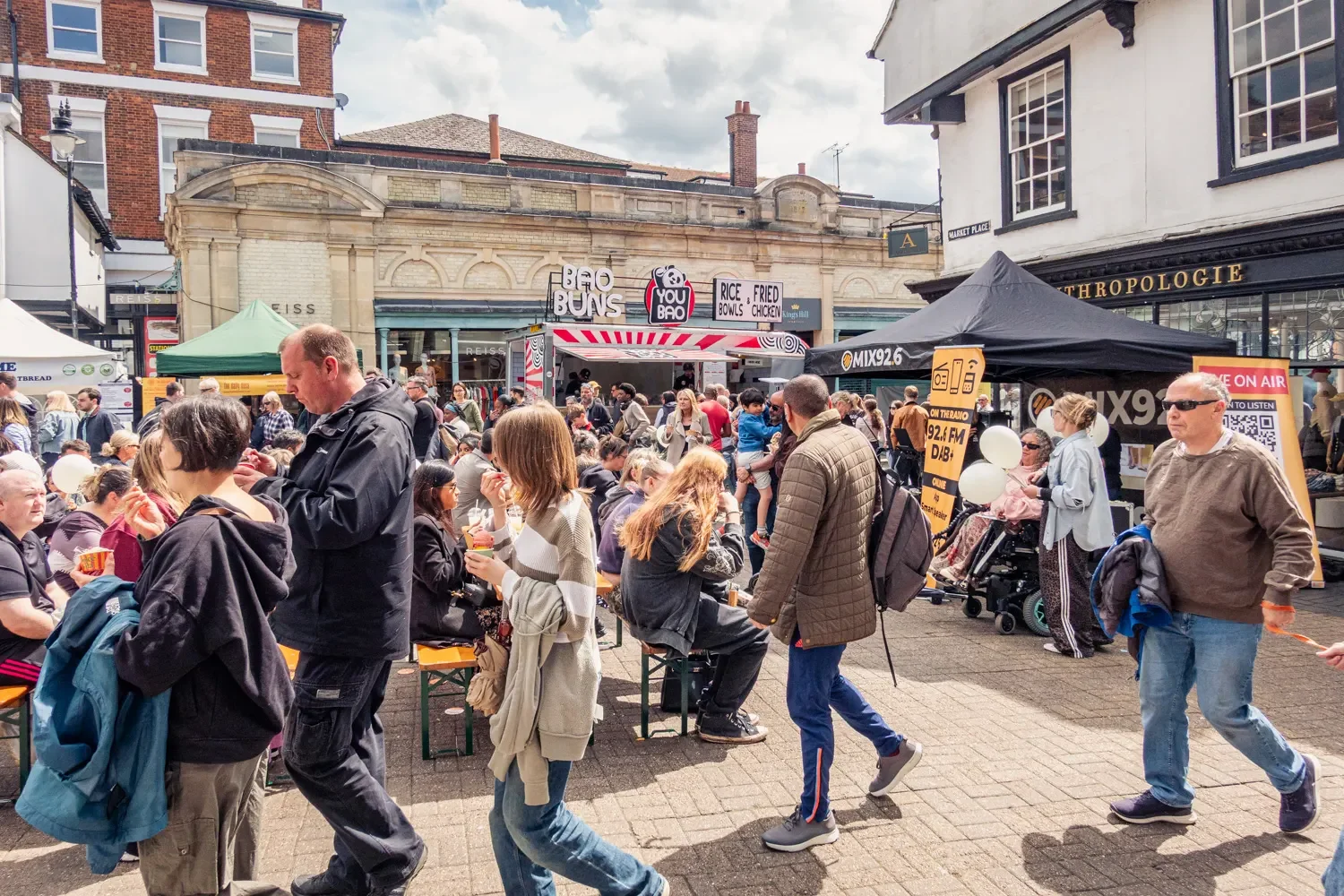
St Albans market at full throttle – shoppers, street food, and a live radio broadcast all in one frame.
Why this kind of commission matters
BIDs, local authorities, and town centre partnerships often rely on stock photography or ad-hoc images taken on phones. For a ballot submission, where you’re making a case to levy payers for continued funding, that’s a risk. Professional photography signals that the organisation takes its work seriously, and it gives communications teams a proper asset library they can draw on for years.
If you work for a Business Improvement District, a local authority, or a town centre partnership anywhere in the UK and need a photographer who can work to a structured brief across multiple sessions, I’d be glad to talk through what’s involved.
Get in touch here, or visit corporate photographer St Albans & Hertfordshire to see the full range of my work.
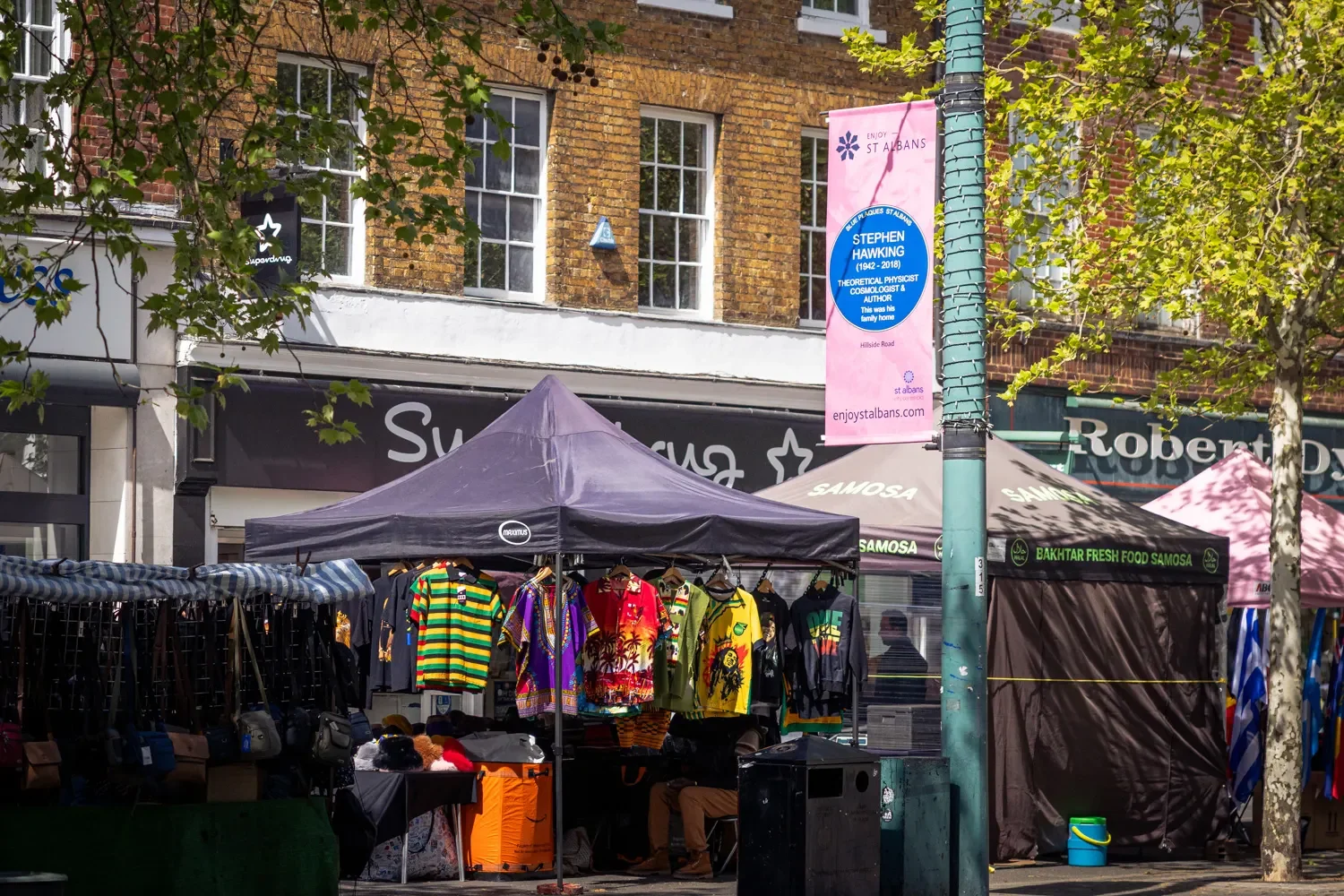
The BID’s blue plaque banners celebrate notable figures connected to St Albans – including Stephen Hawking, whose family home was on Hillside Road.

The museum benches – a natural gathering spot at the heart of the town centre.
Q&A
What does a BID photography commission typically involve? Most BID commissions involve multiple sessions across different times of day, covering a set list of subjects, street furniture, lighting, signage, murals, and general street life. The brief usually includes both daytime and evening shots, and images need to be delivered in formats suitable for print, web, and social media.
How many images should a BID commission for a ballot submission? It depends on the number of subjects and locations, but a thorough commission covering seven subject areas across a city centre would typically produce 150–300 images after culling and post-processing. Quality and variety matter more than volume.
How long does a BID photography project take from start to finish? For a project of this scale, five sessions, seven subjects, 257 final images, allow four to 2-3 weeks from first session to final delivery. That includes time to return to locations if conditions aren’t right, plus post-processing and export.
Can a photographer work to a specific brief set by a Business Improvement District? Yes, and it’s the right way to approach it. A structured brief with defined subjects, locations, and intended uses makes the whole project more efficient and ensures the images actually serve the purpose they're needed for.
Does the photographer need to understand what the images will be used for? Absolutely. Knowing that images will appear in a ballot submission document, on social media, in printed leaflets, and on a website changes how you shoot, resolution, composition, and format all need to account for those different contexts from the start.