
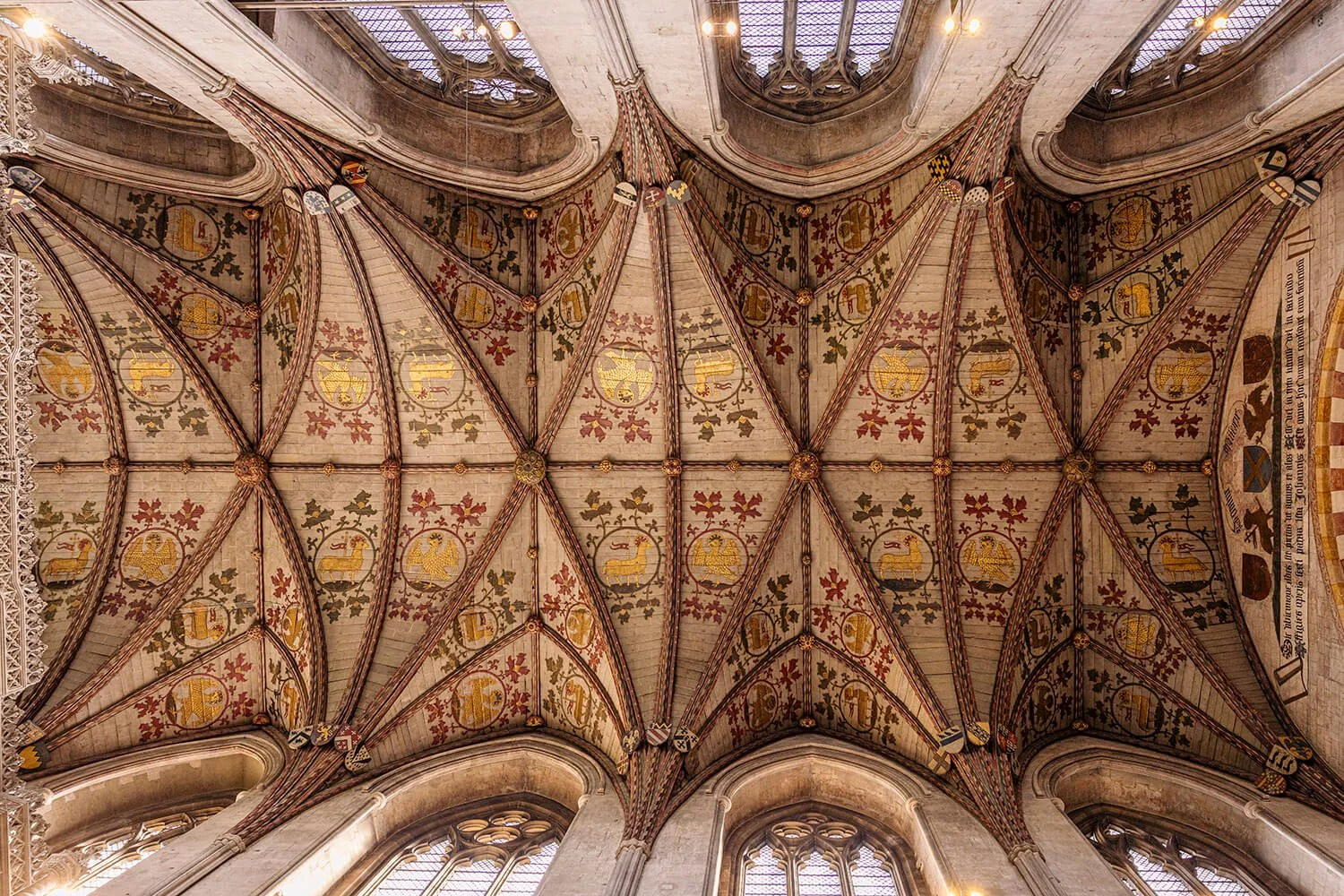
The vaulted ceiling above the Presbytery, St Albans Cathedral. Painted panels depicting lambs and eagles, dating from the 13th century and redecorated in the 15th. One of my favourite details to point out on a shoot.
I’ve been a professional photographer based in St Albans for over 17 years and have lived here for 23 years. That’s a long time to get to know a city – long enough to know where the light does something special in the late afternoon, which passageways most people walk straight past, and which walls make the perfect backdrop for a portrait session.
This guide is two things at once. It’s a proper photowalk for anyone with a camera who wants something more interesting than the postcard shots. And it’s a window into how I think about location when I’m planning a professional shoot, whether that’s a personal branding session, a corporate headshot, or a family portrait.
The texture, the history, the hidden detail – these are things a plain studio simply can’t give you. St Albans has all of that in abundance, and most of it goes completely unnoticed.
1. Pemberton Almshouses – the arrow and the widow
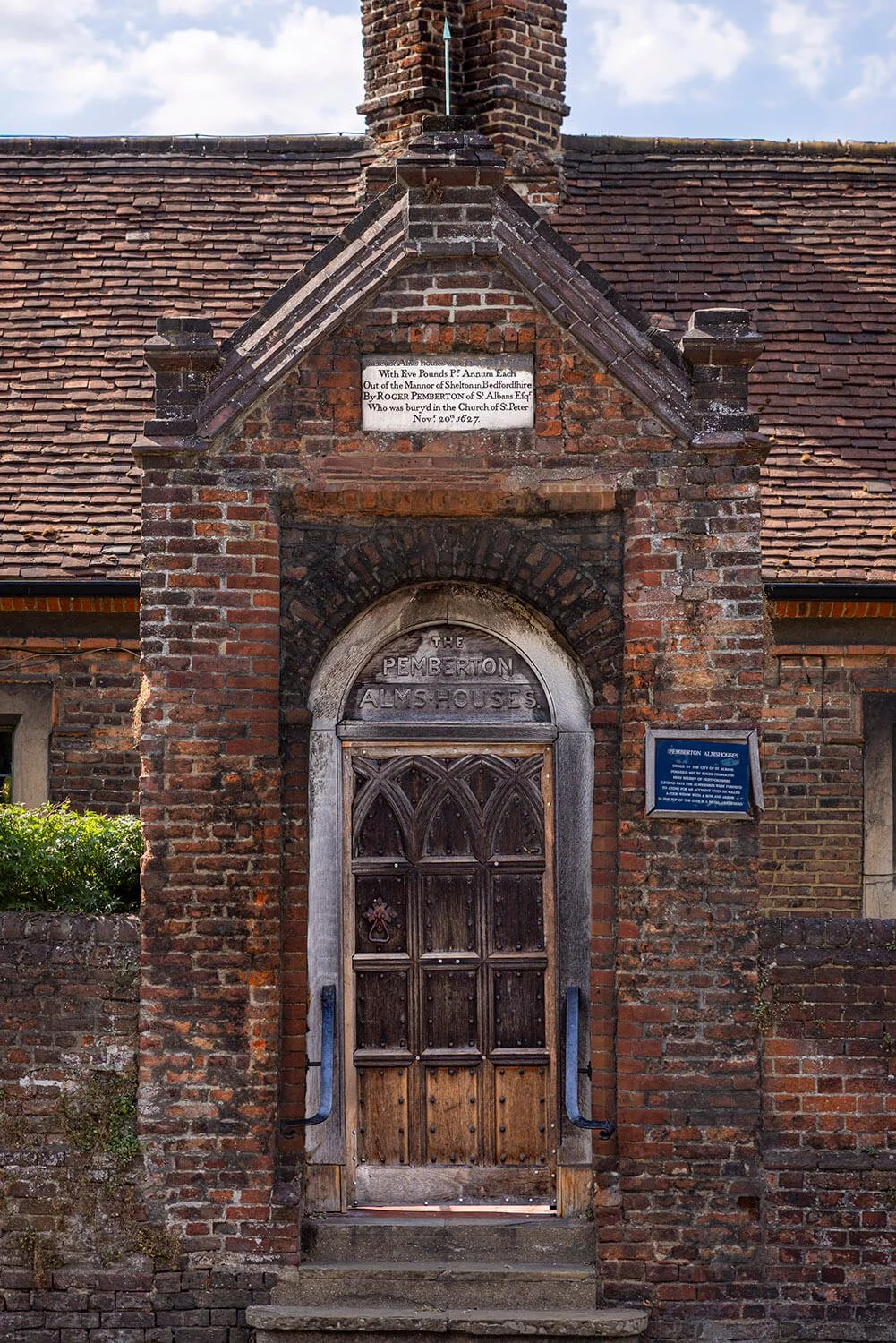
The Pemberton Almshouses, St Peter's Street, St Albans. Built in 1629 to house six poor but respectable widows. The iron spike above the gate marks the spot where Roger Pemberton is said to have accidentally shot a widow, and funded the building in repentance.
Start your walk on St Peter’s Street and look for the beautiful Pemberton Almshouses, built in 1629 to house what the original deed describes as “six poor but respectable widows.” Above the gate you’ll spot a sharp iron spike said to mark the spot where Roger Pemberton accidentally shot a widow with an arrow. As the story goes, he funded the almshouses in repentance.
True or embellished, it’s exactly the kind of detail that makes St Albans so endlessly interesting to photograph. The ironwork, the worn brickwork and the symmetry of the arched gateway are also a genuinely brilliant backdrop for portraiture – soft, contextual, full of character.
→ Head south down St Peter's Street towards the town centre.
2. Commit no Nuisance – the Clock Tower door

The door at the base of St Albans Clock Tower, High Street. The hand-painted instruction ‘Commit No Nuisance'‘is a genuinely oddly charming survival from medieval public order. The tower itself dates from the early 1400s and is the only surviving medieval clock tower in England.
On the High Street you’ll find St Albans Clock Tower – the only surviving medieval clock tower in England, built in the early 1400s. Most people walk past. Those who stop notice a worn wooden door at the base with a hand-painted instruction: ‘Commit No Nuisance.’
It’s a delightful piece of public order history that sounds faintly absurd today. As a photography subject, the contrast between the ancient stonework and the oddly polite warning makes for one of those detail shots that stops people when you share it.
This is also one of those locations I often use as a mid-shoot stop on a personal branding session – the textures and scale work brilliantly as environmental context for a portrait.
→ Continue a few steps down to Chequer Street.
3. The Bat & Ball – St Albans’ smallest pub
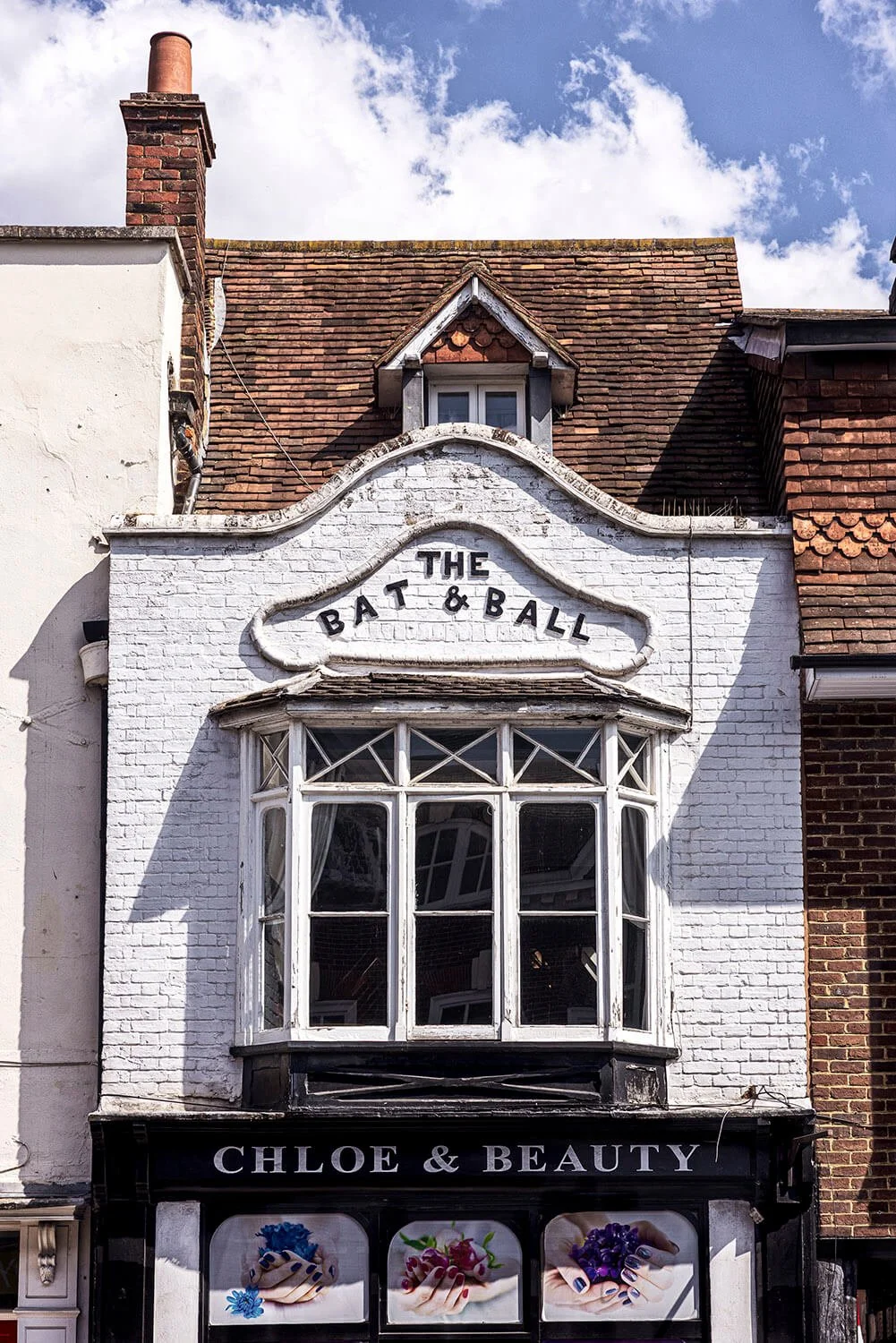
The former Bat and Ball pub, Chequer Street, St Albans. Once the smallest pub in St Albans, it closed in the early 1980s. The signage remains. The upper floors – a 16th-century timber-framed building, are now an Airbnb, and are said to be constructed from ship timbers dating back to the reign of Henry VIII.
Tucked between modern shops on Chequer Street is the former Bat & Ball, once the smallest pub in St Albans. It closed in the early 1980s but its carved wooden signage is still there if you know to look. The upper floors of the 16th-century timber-framed building are said to be built from ship timbers from the reign of Henry VIII – and are now available as an Airbnb.
The contrast between that deeply old building and the surrounding contemporary shopfronts is what makes it interesting photographically. It's exactly the kind of detail that rewards curiosity.
→ Backtrack slightly and cross over to Waxhouse Gate.
4. Waxhouse Gate – history in a passageway

Waxhouse Gate, St Albans. A narrow medieval passageway that once carried traders and pilgrims between the Abbey Quarter and the High Street. The worn stones and natural framing make it one of the most atmospheric photography locations in the city.
Waxhouse Gate is a narrow, atmospheric passageway linking the Abbey Quarter to the High Street. Once a busy thoroughfare for medieval traders and pilgrims, it now feels like a side door into another century. Most people miss it entirely.
The natural light that falls through the gate at certain times of day is genuinely extraordinary, it creates a framing and depth that I’ve used on more than one personal branding shoot. The worn stone underfoot and the glimpse of the Clock Tower through the arch are the kind of visual details that make a location earn its place in an image.
→ Head through into the Cathedral grounds and step inside.
5. Medieval graffiti in St Albans Cathedral
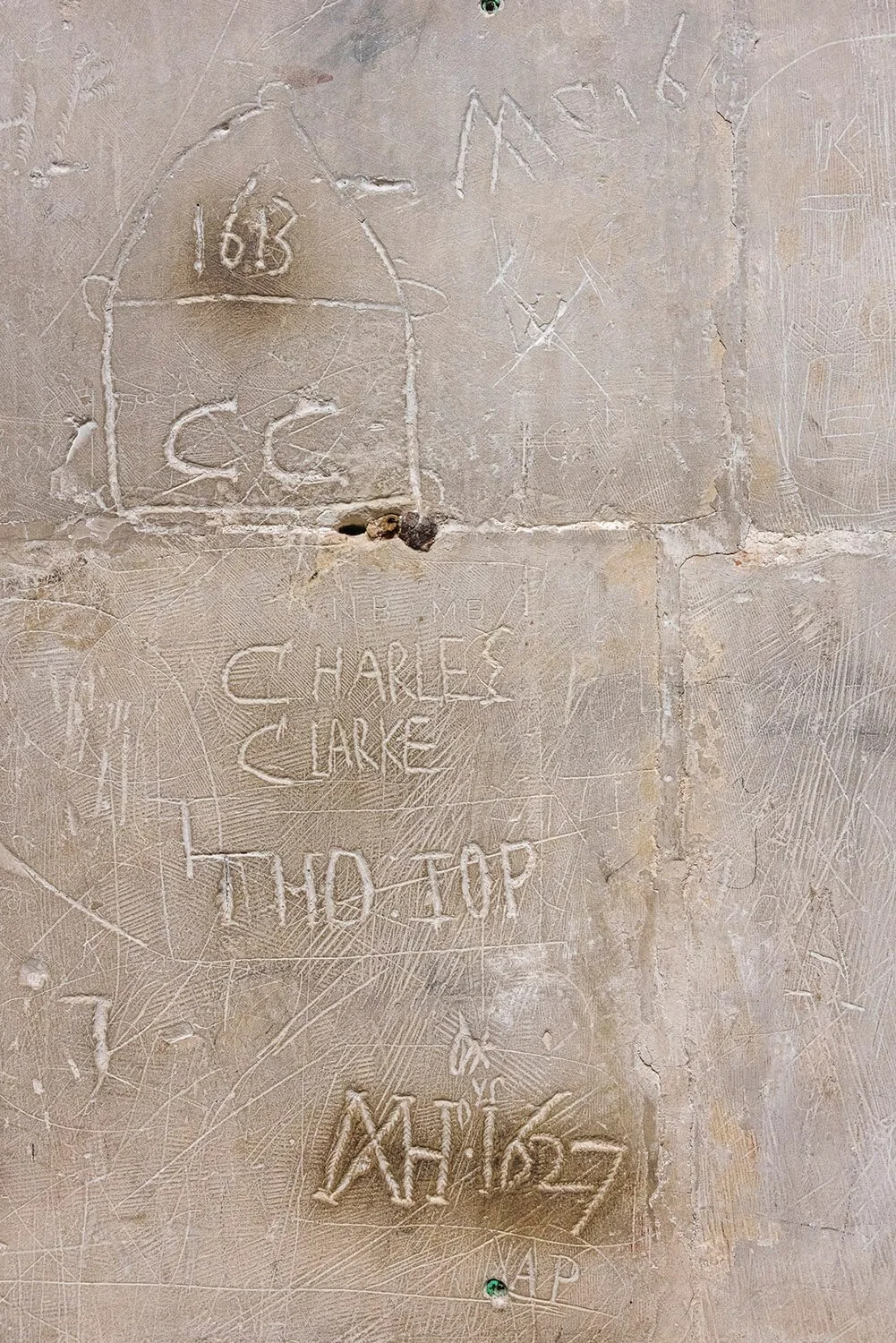
Medieval graffiti inside St Albans Cathedral. Names, symbols and marks made by pilgrims, masons and choirboys over hundreds of years. Bring a torch – much of it is only visible in raking light.
Inside the Cathedral, hidden among the ancient stonework, you’ll find some of the most unexpected subjects in the city – medieval graffiti. Carved over centuries by pilgrims, choirboys, masons and visitors, these marks are scattered throughout the Norman Tower and the Cloisters. Names, symbols, compass-drawn circles, small doodles.
They’re genuinely moving in a quiet way. Not grand history – just ordinary people leaving a trace. Photographically, they require patience and a torch. Much of it is only visible in raking light at a low angle. Bring a zoom lens and take your time.
→ One final, slightly spooky stop – head towards Lower Dagnall Street.
Bonus stop: the Succubus of the Christopher Inn

The succubus carving at the Christopher Inn, French Row, St Albans. A figure from medieval folklore, believed to seduce men in their sleep. Her shackled feet aren't a warning – they're a symbol of protection, showing the inn was safe from evil spirits.
Outside the Christopher Inn, look up and you’ll see one of St Albans’ strangest carved figures. This is the succubus – a voluptuous demon from folklore, believed to visit men in their sleep. Her goat’s feet are shackled together, and that detail is key: it’s not a warning but a symbol of protection. The inn was safe from evil spirits.
It’s bizarre, historically fascinating, and looks spectacular in a photograph. One of those finds that makes local knowledge genuinely valuable.
Thinking about a professional photoshoot in St Albans?
People who get in touch for a personal branding shoot or headshot session often ask me about outdoor locations. This walk is exactly why I love shooting in St Albans. These aren’t generic park benches – they’re places with hundreds of years of story behind them, and that comes through in the images.
The textures, the scale, the quality of light through a medieval gate or against 400-year-old brickwork, it adds real character to professional portraits in a way that a plain studio simply can’t. Every professional shoot I do outdoors in St Albans starts with knowing this city well enough to match the right location to the right person.
If you’d like to book a personal branding session, corporate headshot or family portrait that makes full use of these extraordinary locations, I’d love to hear from you.
Your St Albans photowalk at a glance
This route covers around 1.5 miles and is ideal for a relaxed hour or two with a camera. Whether you’re shooting for a personal project, building your street photography portfolio, or just exploring, these are some of the more unusual things to photograph in St Albans.
Best light: early morning for the Cathedral interior, late afternoon for the High Street and gate textures. Weekday mornings are quietest if you want clear shots without foot traffic.
This is part one of the photowalk. Part two covers eight more locations – including a relocated 17th-century barn, an Art Deco building connected to the Ryder Cup, and a genuine Second World War gun turret.
Want photos like a local who knows the best spots? Get in touch
Read part two: 8 more unusual photo spots in St Albans →
Read more: Clarks Camera Centre St Albans – the final shutter on Hollywell Hill →

If you’d like a handy downloadable PDF, simply click this link
Frequently asked questions
Where are the best photography locations in St Albans?
For unusual or characterful locations, the best spots are Waxhouse Gate, the Clock Tower on the High Street, the Pemberton Almshouses on St Peter’s Street, and inside St Albans Cathedral. Each has strong architectural detail and interesting light at different times of day. For professional shoots, I also use the Cathedral grounds, the Roman walls at Verulamium Park, and the timber-framed buildings along French Row.
Can you use St Albans as a backdrop for a professional headshot or personal branding shoot?
Absolutely – it’s one of the things that sets a St Albans shoot apart. I’ve photographed personal branding sessions, corporate headshots and family portraits against the Almshouses, Waxhouse Gate, the Cathedral west front and several other locations across the city. The combination of ancient stone, varied textures and interesting framing means every shoot looks genuinely different.
Do I need a permit to photograph in St Albans Cathedral?
Personal photography and tourism photography inside St Albans Cathedral is generally permitted without a permit. Commercial photography – for advertising, publications or professional purposes – may require prior arrangement with the Cathedral. I always check access permissions in advance for professional client shoots.
How long does the St Albans photowalk take?
The route covering all five main stops plus the bonus succubus carving takes around 60 to 90 minutes at a relaxed pace. If you go inside the Cathedral to hunt for the medieval graffiti, add another 30 minutes. Combine this walk with part two and you’ll have a full half-day of photography.
I’m based in Hertfordshire – can I book a personal branding photographer near me?
Yes. I’m based in St Albans and work across Hertfordshire, covering Harpenden, Hemel Hempstead, Watford, Welwyn, Hertford and London. Most of my personal branding and headshot sessions take place in St Albans itself – using locations like these – but I regularly travel across the county for client shoots. Get in touch and we can find the right location for you.
Mike Dick is a professional photographer based in St Albans, Hertfordshire. He specialises in personal branding photography, corporate headshots and event photography for businesses and professionals across Hertfordshire and London. He has lived in St Albans for 24 years.