
Composite photography – how I built one impossible image from dozens of real ones
A behind-the-scenes look at composite photography, creative problem-solving and what happens when you decide the single frame isn’t enough
There are photographs you take. And then there are photographs you build.
This one I built. And it started with a film about zombies.
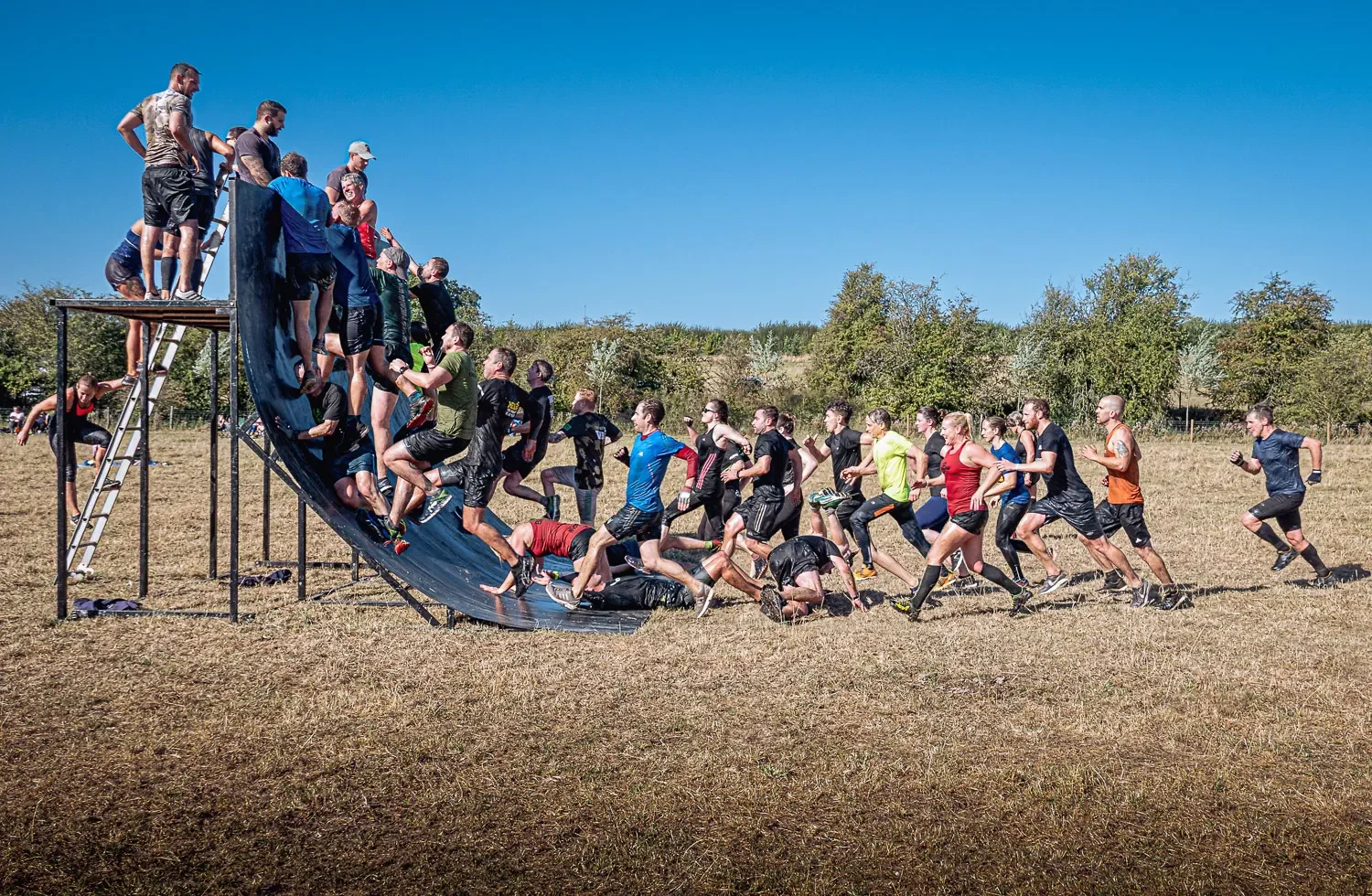
The finished image. What you are looking at never actually happened. At no point during the race were there this many people on the ramp at once. What you are seeing is the accumulated effort of an entire morning, dozens of individual frames layered and masked in Photoshop until the chaos, the energy and the sheer human determination of the day existed in a single impossible frame. This is the image I came away wanting to make. This is why I stood there for ten minutes with my arms locked and my camera on a strap.
I was photographing an obstacle challenge event. Mud, sweat, determination, the usual joyful chaos. At one point in the course there was a steep steel ramp, maybe twelve feet high, and watching the competitors hit it at speed and scramble for the top was genuinely compelling. The effort on their faces, the way bodies stacked and supported each other, the sheer physical commitment of it.
I took some good shots. But standing there watching wave after wave of runners come charging in, I kept thinking: what I want to show is all of this at once. Not one person on the ramp. All of them. Simultaneously. An impossible, surreal pile of human determination that captures not what the scene looked like at any single moment but what the whole thing felt like across the entire race.
World War Z. That was the reference that arrived fully formed. Brad Pitt and the zombies scaling the walls in a writhing, impossible mass. That’s the image I had in my mind I wanted to create and that’s the photograph I’m going to build.
The technical challenge: no tripod, no assistant, just stubbornness
Here is where it gets practical, because the interesting part of this story is not the ambition, it is the problem-solving.
I didn’t have a tripod with me. I had a small compact camera, a camera strap, and the kind of pig-headed determination that occasionally produces good results. The composite technique I had in mind requires the camera to be in exactly the same position for every single frame. Even a small shift between shots makes the masking in post-production exponentially more difficult, because the background moves and nothing lines up cleanly.
My solution was to wrap the camera strap tight around the back of my neck, extend both arms fully in front of me, and use my own body as the stabiliser. Arms locked. Feet planted. Camera in manual mode with focus locked to a fixed point on the ramp. No autofocus hunting between shots, no exposure variation, no surprises.
I stood there for ten solid minutes. Barely breathing. Camera out in front of me at full stretch, firing continuously as wave after wave of competitors came through. Dozens and dozens of frames, most of which I would never use, all taken from exactly the same position with exactly the same settings.
It’s not elegant and it’s not how you’re supposed to do it. But it worked.
Building the composite in Photoshop
The source material. Each of these frames was shot from exactly the same position over ten minutes. In reality, there were never more than three or four people on the ramp at once.
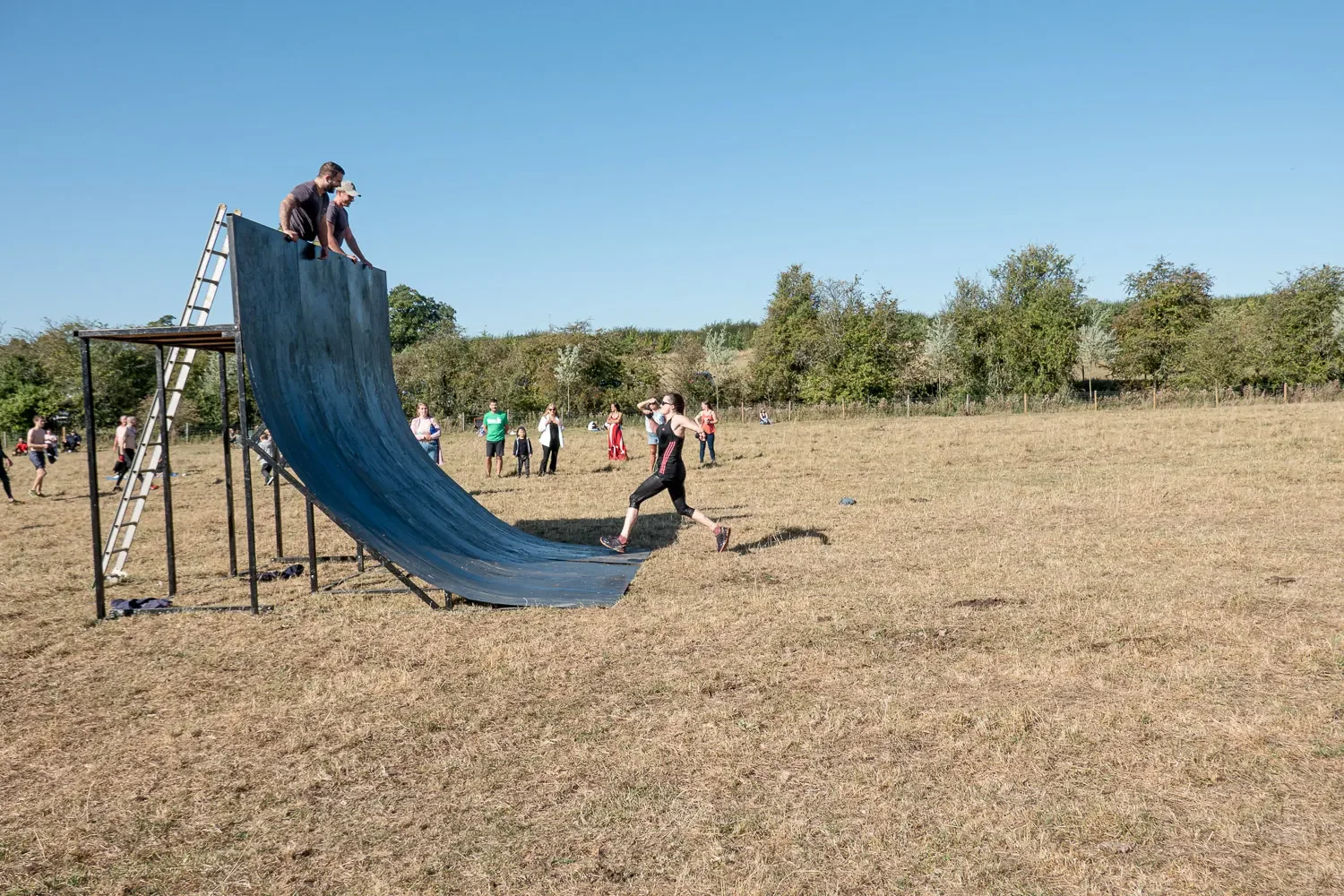
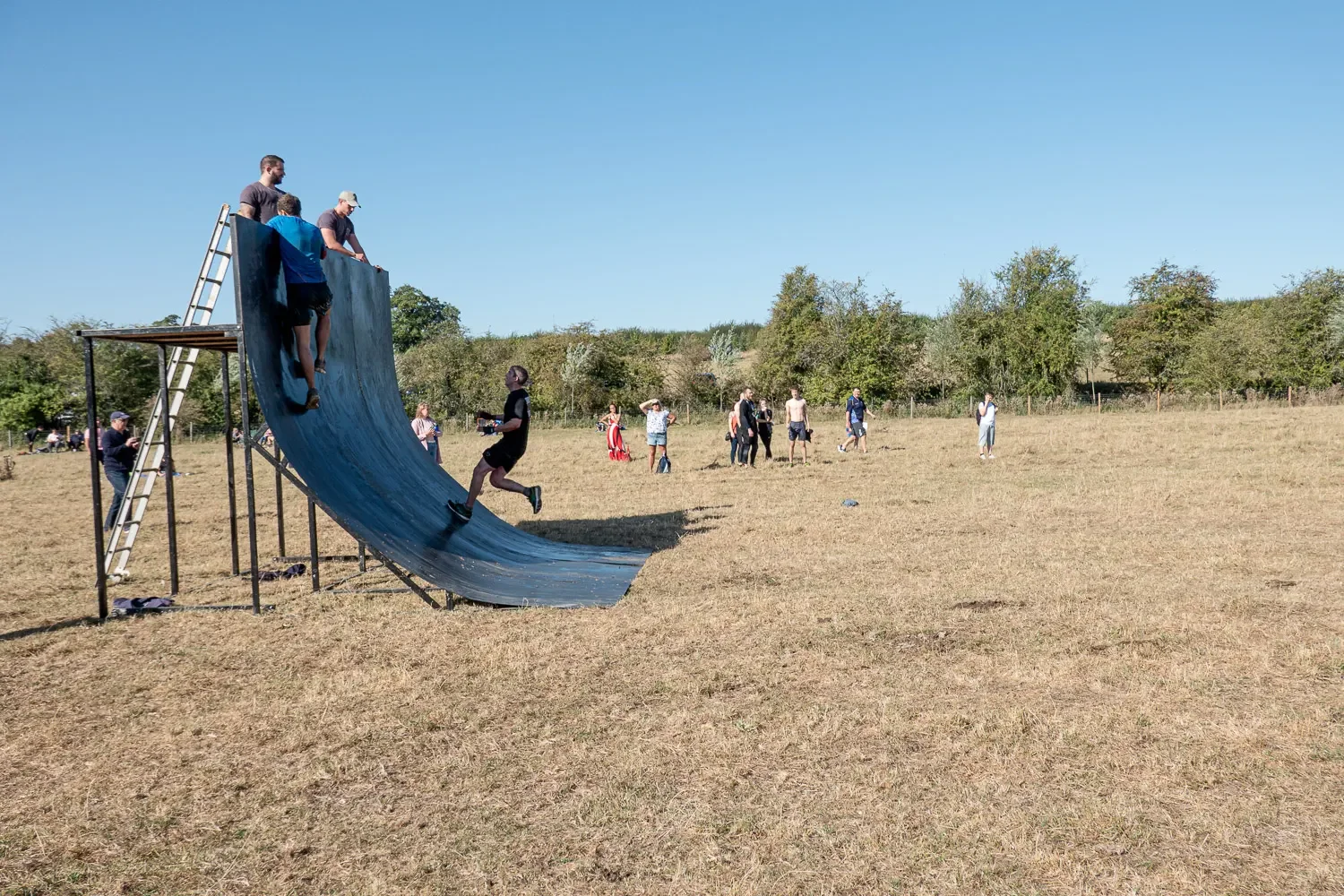
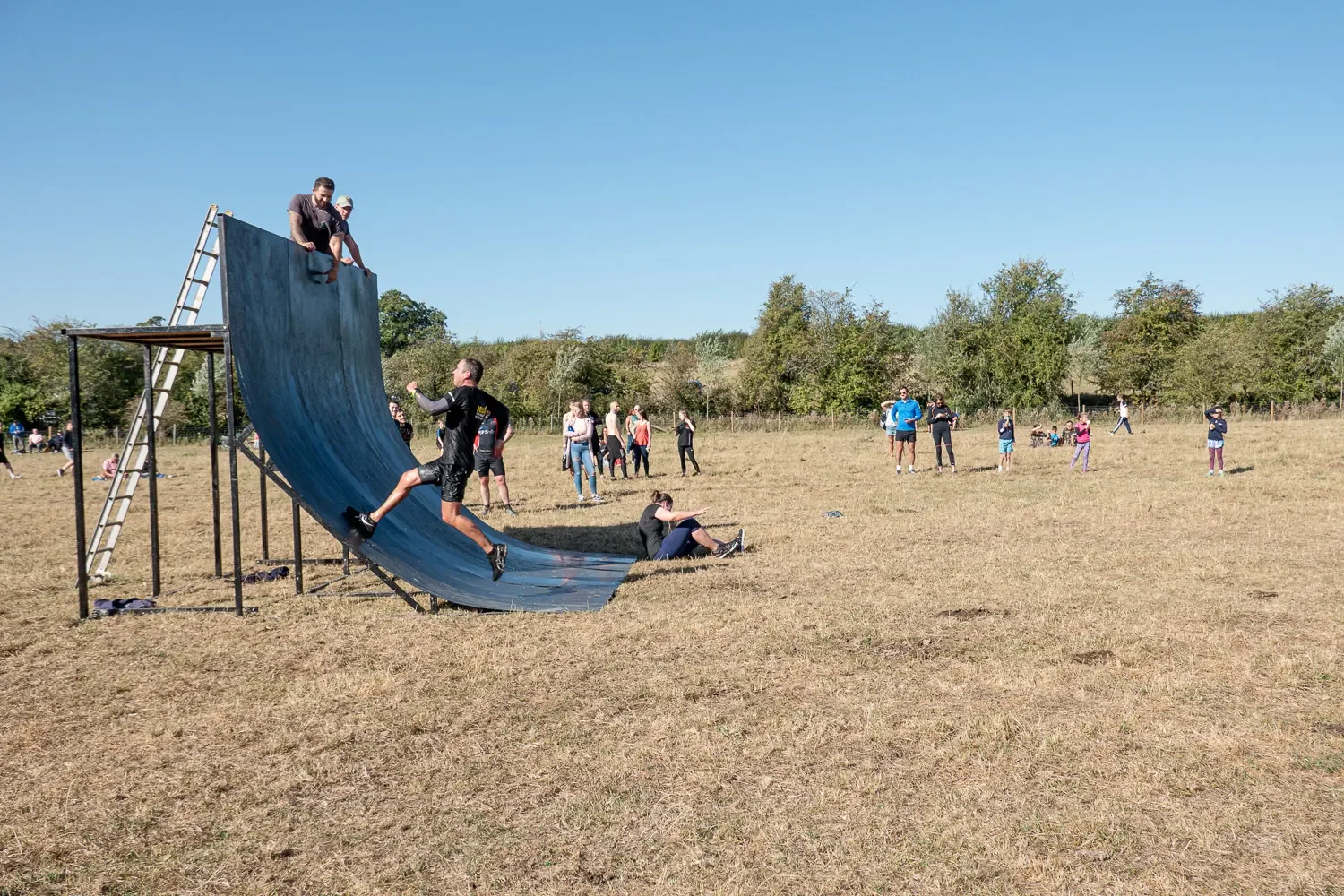
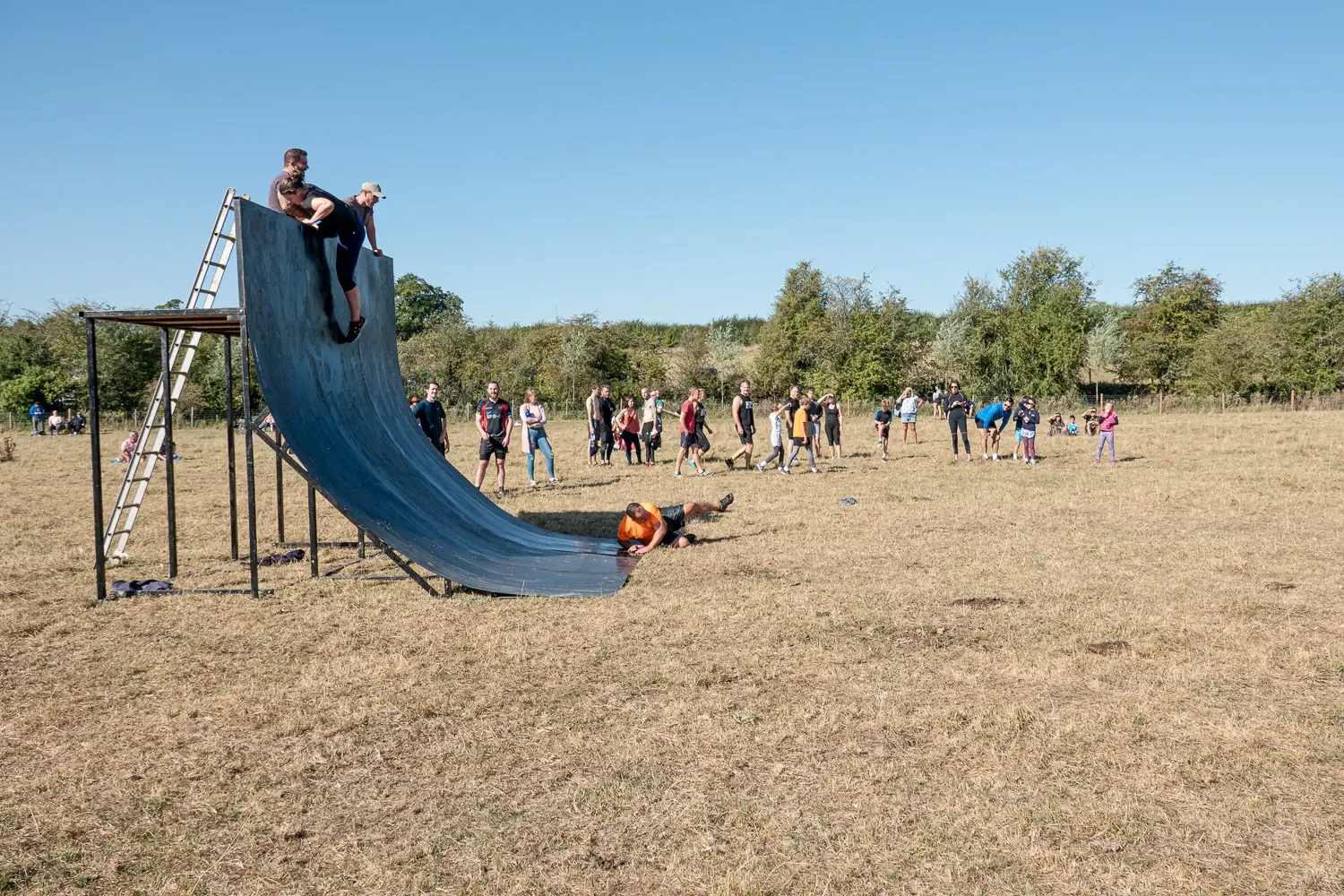
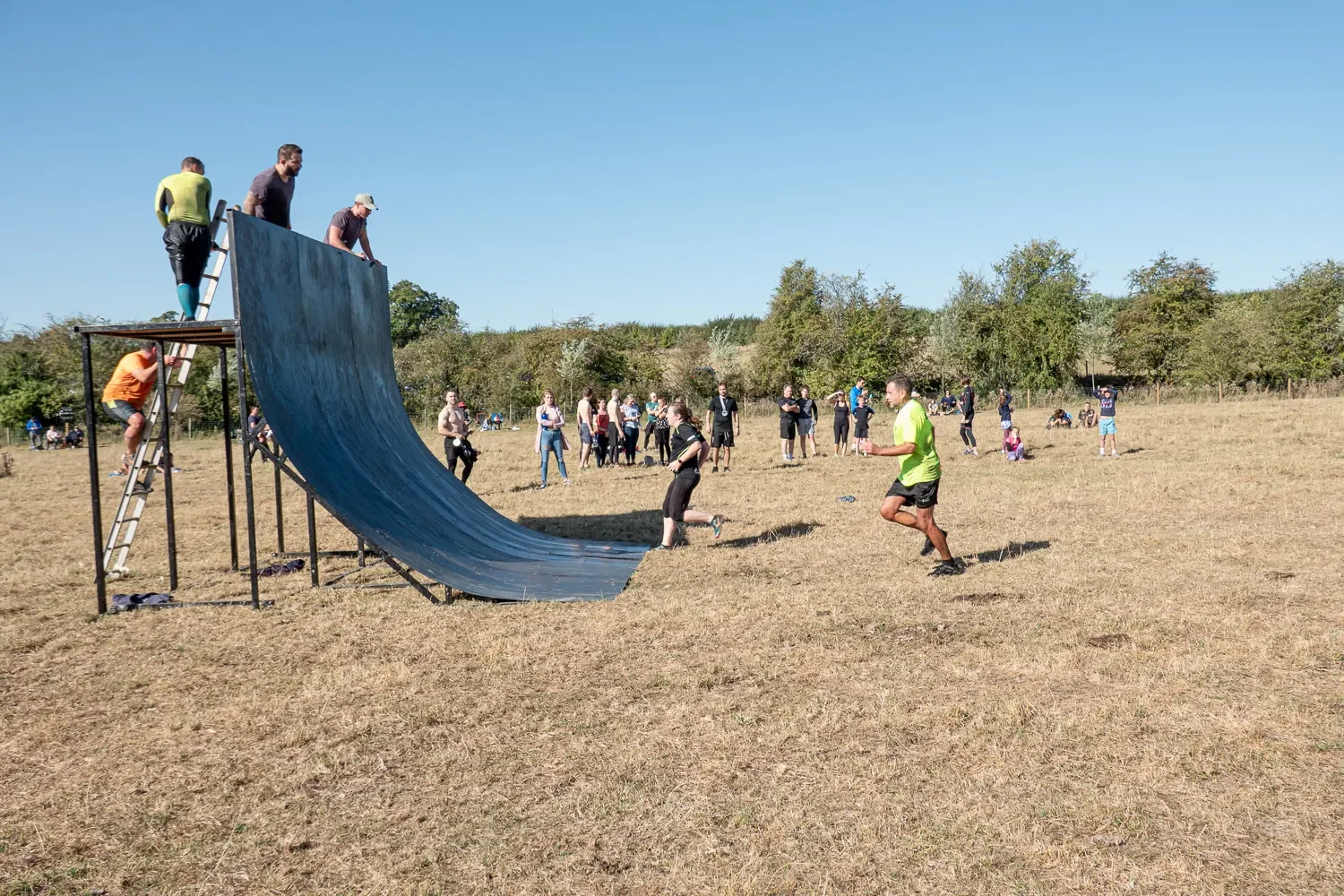
These are five of the dozens of individual source frames shot from exactly the same fixed position over ten minutes, camera in manual mode, focus locked, exposure consistent throughout. In reality there were never more than three or four people on the ramp at any one moment. Each frame shows the obstacle as it actually was: quiet, sparsely populated, nothing like the finished image. The consistency of the background across every single frame is what makes the composite possible at all. Change position even slightly between shots and the masking in Photoshop becomes exponentially harder, because the background shifts and nothing lines up cleanly. The camera strap method held. Compare any one of these frames to the composite above and you understand immediately why the single frame was never going to tell the story.
Back at home, I opened everything in Photoshop and started working through the stack.
The principle of composite photography is straightforward: layer multiple photographs on top of each other, then mask out everything you don’t want in each layer, leaving only the elements you do. In practice, the quality of the final image depends entirely on the precision of the masking and the consistency of the source frames.
Because my camera had stayed still, the background of the ramp was identical in every frame. That meant I could mask each person out cleanly without the background sliding around underneath them. I worked through each image methodically, selecting the figures, refining the edges, adjusting for the way light caught different people differently, and gradually building up the pile of bodies on the ramp.
The aim throughout was to make it feel real rather than artificial. Not a neat arrangement of people in obvious layers, but the kind of chaotic, overlapping scramble that the actual event produced. That required some deliberate randomness in how I positioned and ordered the layers, placing people at the angles and heights they actually occupied during their own runs rather than tidying them into a more visually organised composition.
It took a long time. Several hours across two evenings. But slowly, the fictional moment came together. A ramp full of people, all charging at once, all at different stages of the climb, all caught in the same impossible frame.
In reality, there were never more one or two people on that ramp at once. The image shows something that never actually happened. But it shows, with complete accuracy, what the event felt like.
What this says about photography and creative problem-solving
I think about this project quite often, because it illustrates something I believe genuinely matters in photography: the difference between recording a moment and interpreting one.
Recording is straightforward. Point the camera, press the shutter, capture what is there. Interpretation is harder and more interesting. It asks what you are trying to communicate, what the truth of the experience actually is, and whether the single frame you have captured in the conventional way really conveys that truth, or whether there is a more honest version available if you are willing to work for it.
The composite image is more honest than any single frame from that day, in the sense that matters most: it communicates the energy, the scale, the relentless forward motion of the race in a way that a photograph of three people on a ramp simply cannot. The technique is artificial. The feeling it produces is real.
This problem-solving approach is something I carry through all of my photography work, not just the creative experimental projects. Whether I’m shooting a corporate event, a personal branding session or a brand photography commission, the question I’m always asking is not just what is in front of me, but what is the most truthful and compelling version of this I can produce with what I have available.
Sometimes that means waiting for the right moment. Sometimes it means finding an unusual angle. Sometimes it means standing in one spot for ten minutes with your arms at full stretch because you didn’t bring a tripod.
If you shoot with a compact camera or want to try composite photography
You don’t need expensive equipment to try this technique. What you need is a clear idea of what you want to achieve, the discipline to keep your camera position consistent, and enough patience in post-production to work through the masking carefully.
Composite photography works particularly well for any situation where you want to show rhythm, repetition or cumulative action: runners in a race, commuters on a platform, children playing in a park, spectators at a sporting event. Anywhere there is a pattern of similar movement across time, there is a potential composite waiting to be built.
Start simple. Shoot in manual mode with fixed focus. Use a tripod if you have one, or improvise if you don’t. Take far more frames than you think you need. And in post-production, work slowly and precisely. The masking is where the image is won or lost.
Good luck!