
Colour, shape and light: photography on the Oban to Mull ferry crossing
There is something about ferry journeys that slows everything down. The slow glide across water, the sea breeze, the gradual shift of light as the mainland recedes. I travel to Scotland every year at Easter, and the crossing from Oban to the Isle of Mull is one of those journeys I always look forward to.
On this particular April morning, the light was extraordinary. Clear skies, strong sun, and the kind of sharp shadows that photographers dream about. But what stopped me was not the scenery. It was the ferry itself.


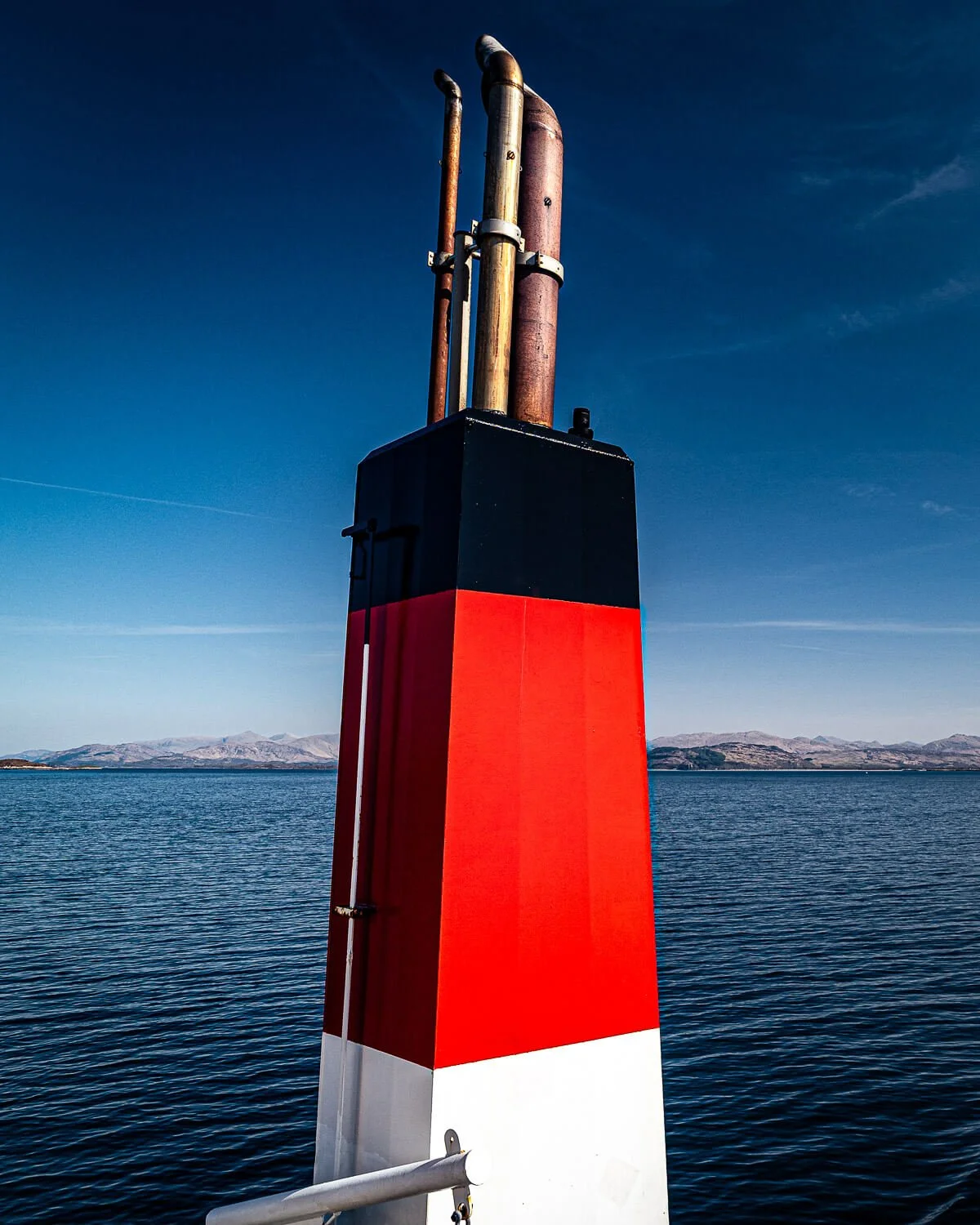

Finding abstract photographs in an industrial space
I had my camera out before we had even left the harbour. The deck was a collision of bold, saturated colour: deep reds from the moulded plastic seating, industrial green steel underfoot, high-contrast yellow safety markings cutting across dark surfaces. All of it thrown into sharp relief by the morning sun hitting at just the right angle.
I found myself not looking towards Mull at all. I was looking down. Looking at edges and shadows, at the geometry of railings and deck markings, at the way the colours sat next to each other. It had a deliberate, almost designed quality to it. A Mondrian moment in the middle of the Hebrides.
This is something I find happens a lot when you travel with a camera and a designer’s eye. The expected subject, the mountains, the lochs, the coastline, gets bypassed in favour of something more immediate and unexpected. The abstract detail hiding in plain sight.
How strong light transforms ordinary subjects
The light was the crucial ingredient. Scotland in April is not renowned for sunshine. So when it arrives, and arrives with that sharp, low-angle quality that comes from northern latitudes, it transforms everything it touches.
Colours that would read as flat and industrial under grey skies became vivid and graphic. Shadows that would disappear in diffuse cloud light became hard-edged and dramatic. The deck of a CalMac ferry became, for the duration of a crossing, a study in colour, texture and geometry.
I noticed the way the yellow safety lines cast their own shadows on the textured non-slip surface underneath, creating a secondary pattern within the primary one. I noticed how the red seating, seen from directly above, lost its functional quality entirely and became something closer to a pattern or a print. I was shooting with a graphic designer's instincts as much as a photographer's.
What this kind of photography teaches you
One of the most useful habits a photographer can develop is learning to look past the obvious subject. The famous view, the expected composition, the shot everyone else takes. Not because those shots are wrong, but because looking beyond them forces you to see differently.
On the crossing to Mull, the obvious subject was the destination. The island appearing on the horizon, the sea, the sky. All beautiful, and all photographed extensively. What interested me was the in-between space. The journey itself, not as context but as content.
This applies to commercial photography too. After seventeen years running photographic projects in a corporate environment, including over 140 photo sessions a year at Columbia Threadneedle Investments across seven international markets, one of the most consistent lessons was that the interesting image is rarely the one everyone expects. It is the moment just before or just after. The environmental detail. The reaction rather than the pose.
The Mull crossing reminded me, in vivid colour, why that habit matters.
Frequently asked questions
Do you need special equipment for travel photography?
No. The images from this crossing were shot with a compact camera. Travel photography rewards curiosity and observation far more than expensive equipment. That said, having a camera you know well, one that responds quickly to unexpected moments, makes a real difference.
What is abstract photography and how does it work?
Abstract photography removes or reduces the recognisable context of a subject, focusing instead on colour, shape, texture, light and shadow. The subject becomes secondary to the visual experience. In practice, it often means getting closer, shooting from unusual angles, or looking for pattern and repetition in unexpected places.
How do you train yourself to see better photographic subjects?
The most effective method is simply to shoot more deliberately. Give yourself constraints: shoot only in one colour palette, or only looking upward, or only focusing on shadows. Constraints force you to look harder and find subjects you would otherwise walk past. My Look Up London project, shooting architectural details in black and white across the City of London, was built entirely on this principle.
What is the best time of day for travel photography?
Early morning and late afternoon, when the sun is low and shadows are long. This applies everywhere, but particularly in the UK and Scotland, where the angle of light even at midday in spring and autumn can be remarkably dramatic. The crossing was at around 8am on a clear April morning, and the light was exceptional.
Can everyday journeys produce interesting photography?
Absolutely. Some of the most compelling photography comes from looking carefully at familiar or functional environments. A commute, a ferry crossing, a car park, a building site. The subject matters less than the quality of attention you bring to it. Photography has a way of revealing the unnoticed, and that works as well on a CalMac ferry as it does anywhere else.