
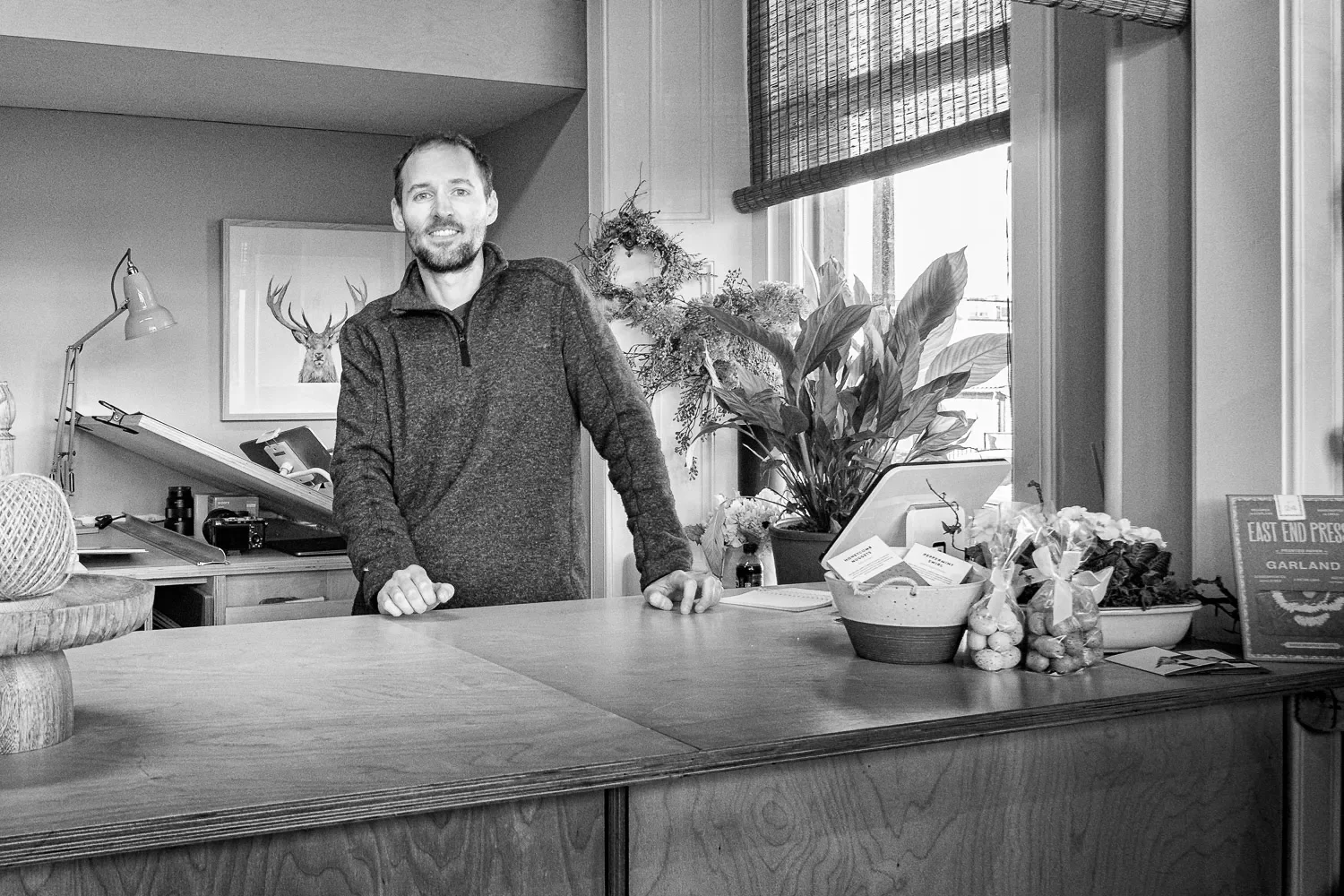
Stuart at the gallery counter – relaxed, standing tall, completely at ease in the space he's spent nearly a year creating. This is the portrait that closes the narrative arc of the shoot: artist becomes business owner, studio becomes gallery, creative vision becomes lived reality.
Stuart Scott – artist, gallery owner, and the man behind SASCO Art, Helensburgh
There's a question I always ask myself before I pick up the camera.
What does this person want people to understand about them and what they do?
Not just how they look. Not just where they work. But the whole picture, who they are, what drives them, and why their business exists. Answer that with a camera, and you don't just have a portrait. You have a set of images that can anchor an entire brand.
That's exactly what this shoot was about.
Stuart Scott and SASCO Art
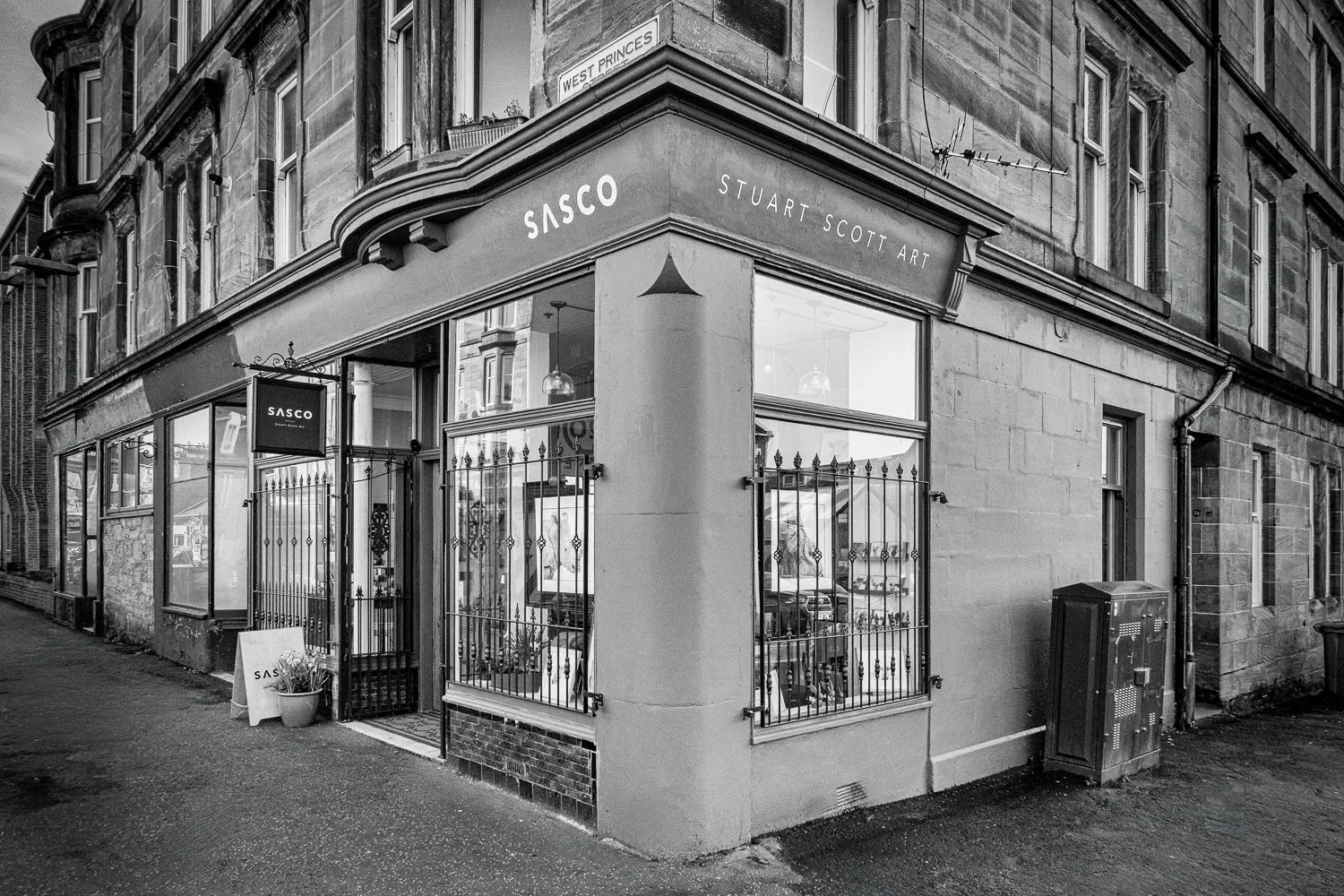
The corner of SASCO Art on West Princes Street, Helensburgh. Nine months of careful, considered work went into every detail of this exterior – from the paintwork to the ironwork. Establishing shots like this are where every brand photography shoot begins. They tell the viewer exactly where they are before a single person appears in frame.
Stuart Scott is a self-taught artist working in pencil. Extraordinarily detailed, photorealistic portraits of wildlife and beloved family pets, deer with vast antler spans, birds of prey mid-gaze, highland cows, inquisitive sheep. The kind of work that makes you stop and look twice, wondering how a pencil could possibly do that.
He's also the owner of SASCO Art on West Princes Street in Helensburgh, Scotland. The name is an acronym of his full name: Stuart Alexander Scott. He spent nine months transforming the space from the ground up, not a quick refurb, but a proper creative overhaul. The exterior paintwork, the interior layout, the lighting, every finishing detail. He approached the shop exactly the way he approaches his illustrations: with patience, precision, and uncompromising care.
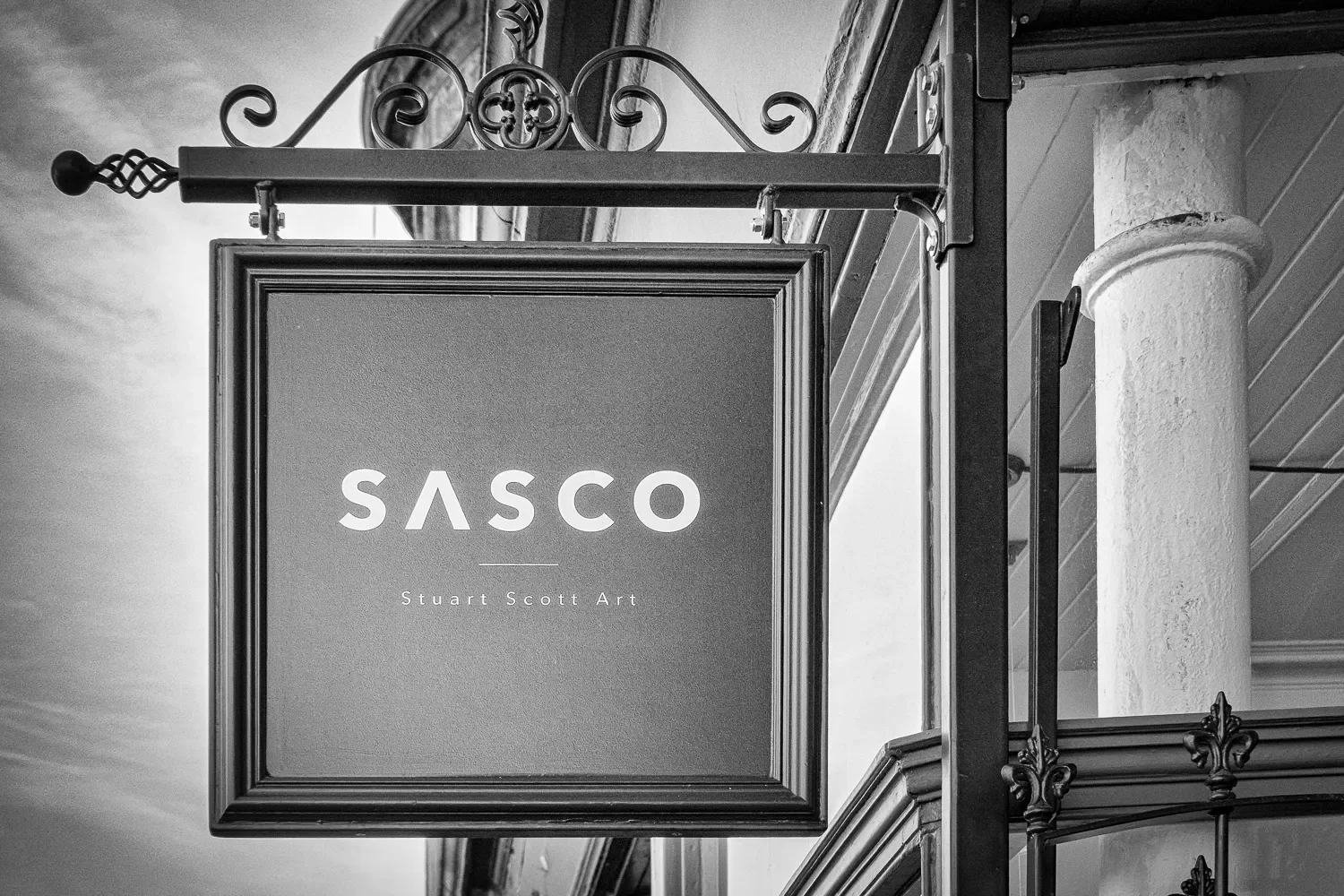
The SASCO hanging sign – clean, modern typography on a dark background, suspended from ornate ironwork. The tension between old and new is one of the defining qualities of the space, and it's visible right from the street.
The result is a gallery and gift shop that feels genuinely considered. Framed pencil artwork lines the walls. A curated selection of homeware, lifestyle products and printed goods fills the front of the shop. At the back, his studio workspace, drawing board, Anglepoise lamp, Sony camera at the ready. Walking in feels like stepping into the pages of a glossy interiors magazine.
Stuart also has a background in web design and graphic design, which shows. This is not a hobbyist who lucked into a shopfront. This is a creative professional who has built every aspect of his business with the same exacting eye.
A personal connection
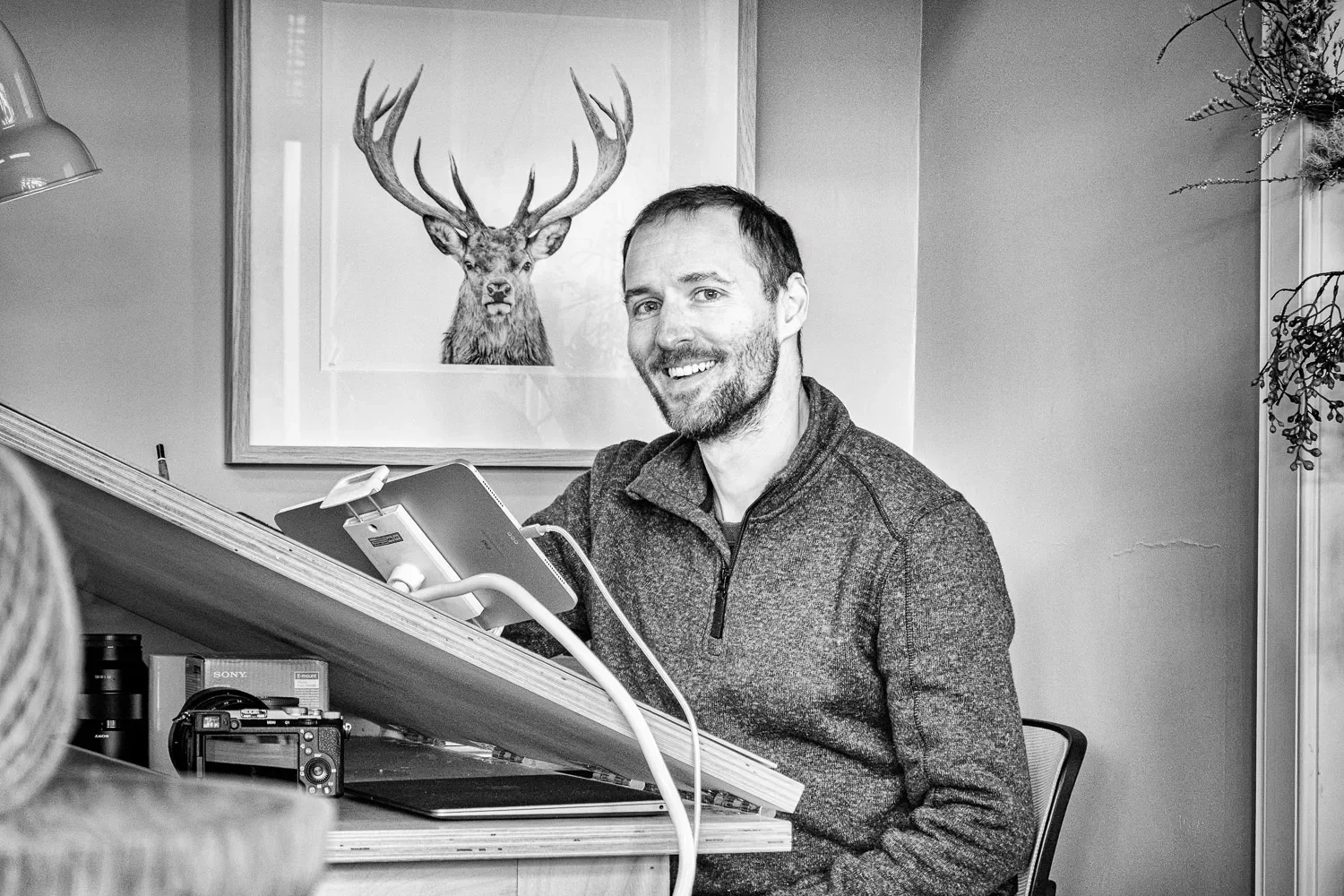
Stuart Scott at his drawing board – the direct gaze that says: this is my business and I'm proud of it. Behind him, one of his signature pencil portraits of a red deer stag. Every element in this frame was already there. Nothing was moved or staged.
This particular shoot carries a bit more weight for me than most.
My dad, Ronnie Weir Dick, was the local photographer in Helensburgh. He owned that very shop from the late 1970s through to the late 1990s. In the years since, it passed through several businesses and had started to decline. I'd been following Stuart's progress on Facebook as he documented the transformation month by month, and when my annual Easter trip back to Scotland came around, I got in touch to ask if I could pop in and take his portrait.
It felt like the right thing to do, a quiet nod to my dad, and a genuine celebration of someone breathing the same kind of creative energy back into a place that deserved it.
Building the narrative through images
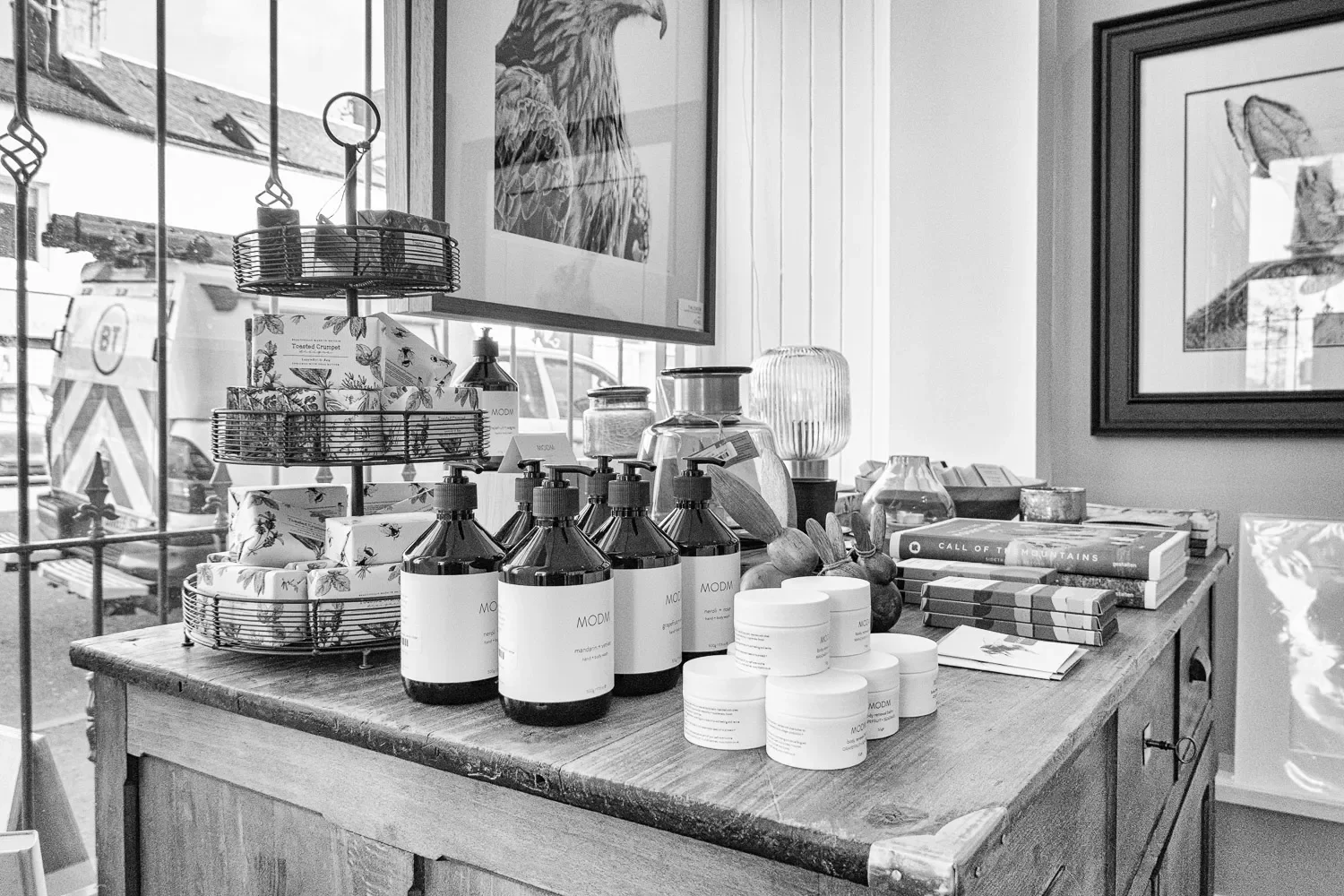
The product display on the main dresser – MODM skincare bottles, art books, glassware, and a large framed pencil portrait of a golden eagle dominating the wall behind. Interior detail shots like this one build the atmosphere of a brand. They show a viewer what it feels like to be in the space before they've ever visited.
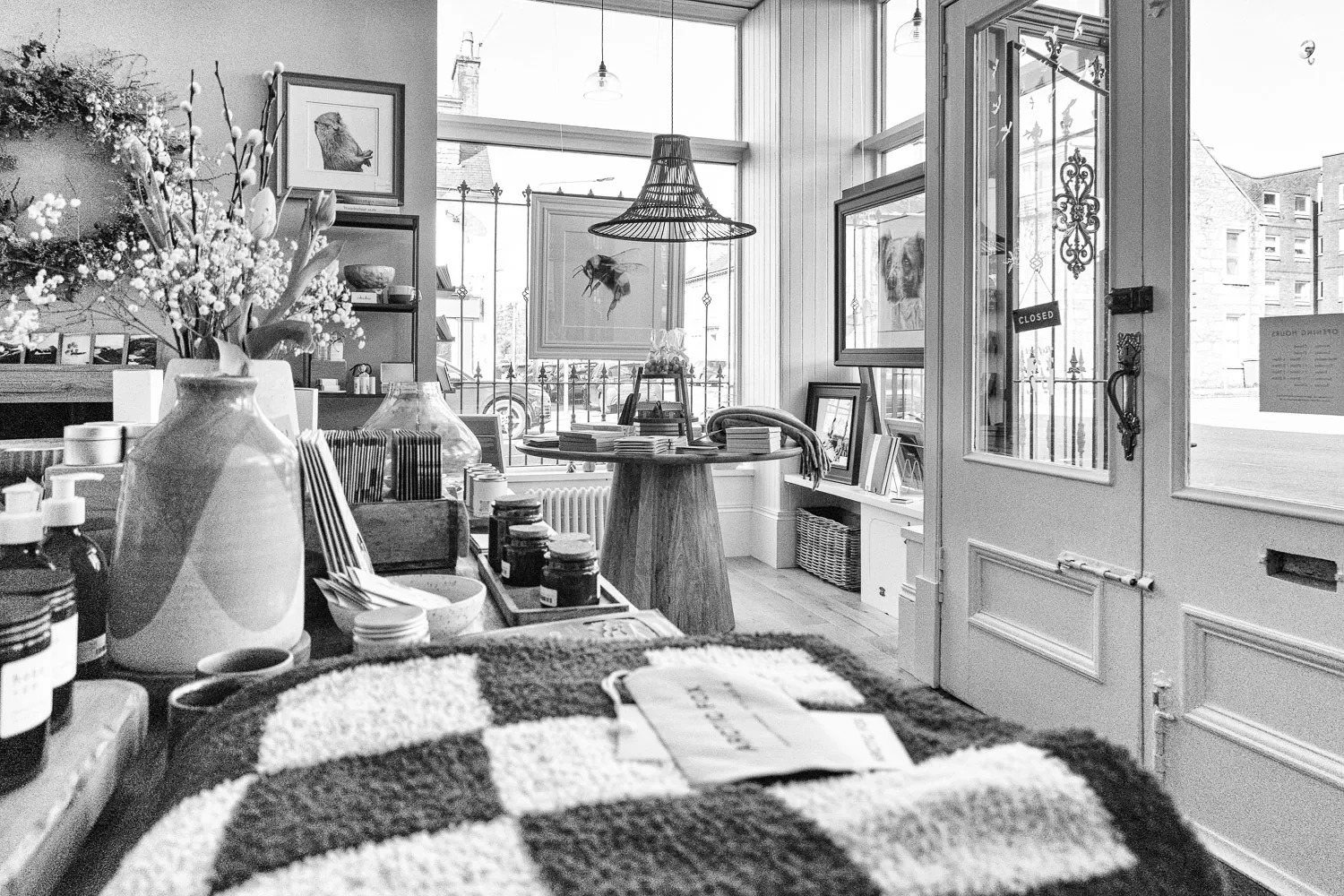
The interior of SASCO Art, shot looking towards the front windows. Framed wildlife prints, fresh flowers, curated homeware, pendant lighting. Before Stuart appeared in front of my lens, I spent time photographing the space itself, because the objects, surfaces and artwork in a well-run creative business tell you everything about the person behind it.
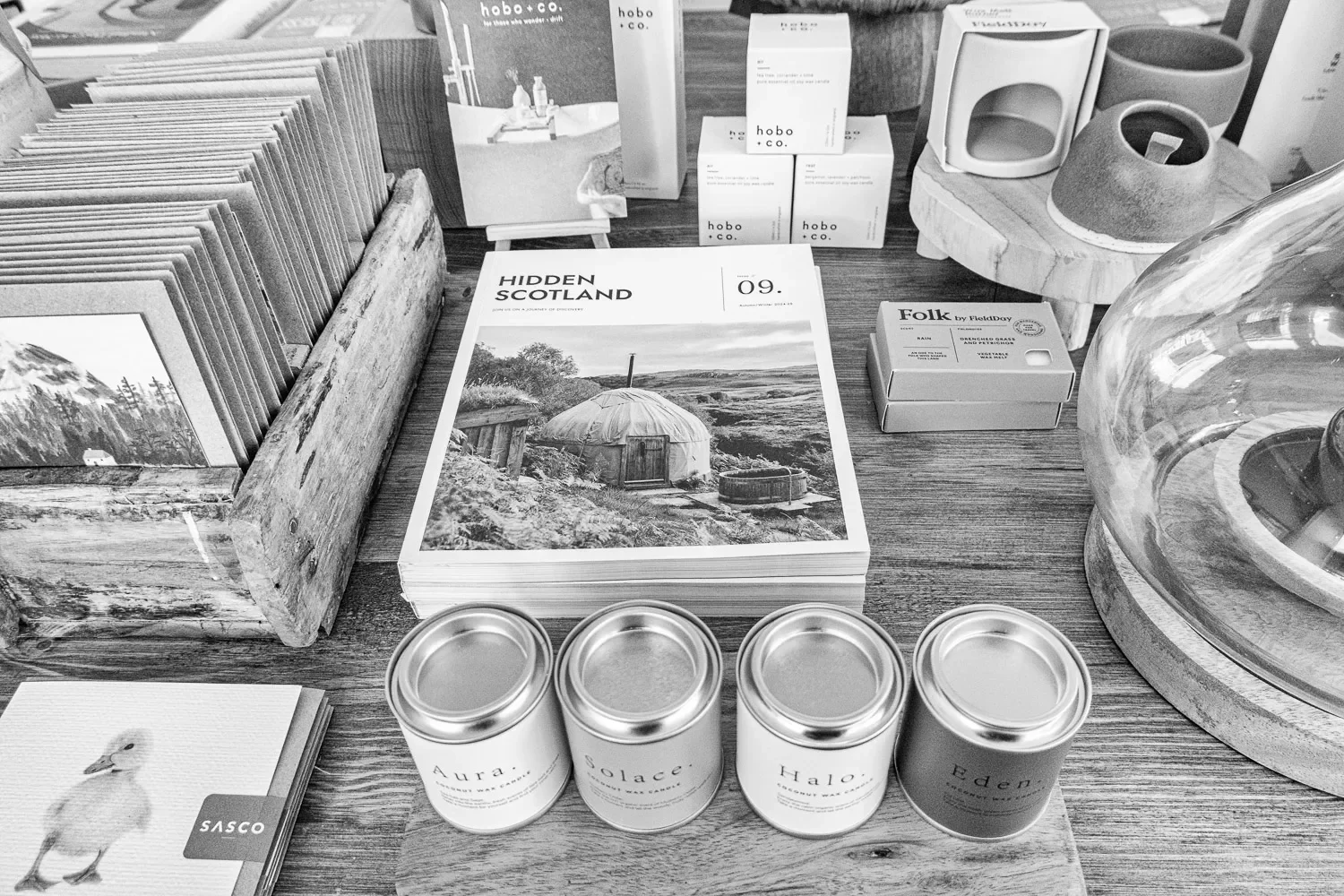
The retail display table: a copy of Hidden Scotland magazine, Hobo + Co products, Folk by FieldDay, and four coconut wax candles – Aura, Solace, Halo, Eden – lined up in a row. The details matter. These images aren't background filler; they're the supporting cast that makes the whole story believable.
This is where I want to talk about the photography itself, because the approach here is one I use for every business portrait shoot I do, and it's worth understanding why it works.
A single headshot tells you what someone looks like. A set of environmental portraits tells you who they are.
The key is to build the shoot in layers, starting from the outside and working in. I started with the exterior, the corner of the building, the hanging sign, the ironwork, the painted fascia. These establish place and context. A viewer seeing these images for the first time immediately understands: this is a real, physical business. It has presence. It has character.
From there I moved inside. Before Stuart appeared in a single frame, I photographed the space itself, the gallery wall, the product displays, the surfaces and objects that fill the room. Every item in a well-run creative business is a clue. The Hidden Scotland magazine on the table. The MODM bottles lined up on the dresser. The framed eagle above the window. The four named candles, Aura, Solace, Halo, Eden – arranged in a row. Each image adds a layer to the story of what this business is and who it's for.
Only then did I bring Stuart into the frame.
The first portraits show him at his drawing board, the place where the work actually happens. One image with him looking directly at camera, engaged and open. Another with him absorbed in the work itself, unaware of the lens. Both are necessary. The direct gaze says: here I am, this is my business, I'm proud of it. The working shot says: this is what I actually do, and I'm completely at home doing it. Together they show a rounded, believable person, not a posed subject, but someone captured in their natural environment.
The final portraits show Stuart at the gallery counter, the point where artist meets customer. Relaxed, standing tall, comfortable in the space he's created.
Taken as a set, these images work as brand assets. They're not just nice photographs. They're content that can populate a website homepage, an About page, a Facebook business page, an Instagram grid, a Google Business profile. Stuart is already using them across his social channels, and they'll anchor his new website when it launches.
The decision to go black and white
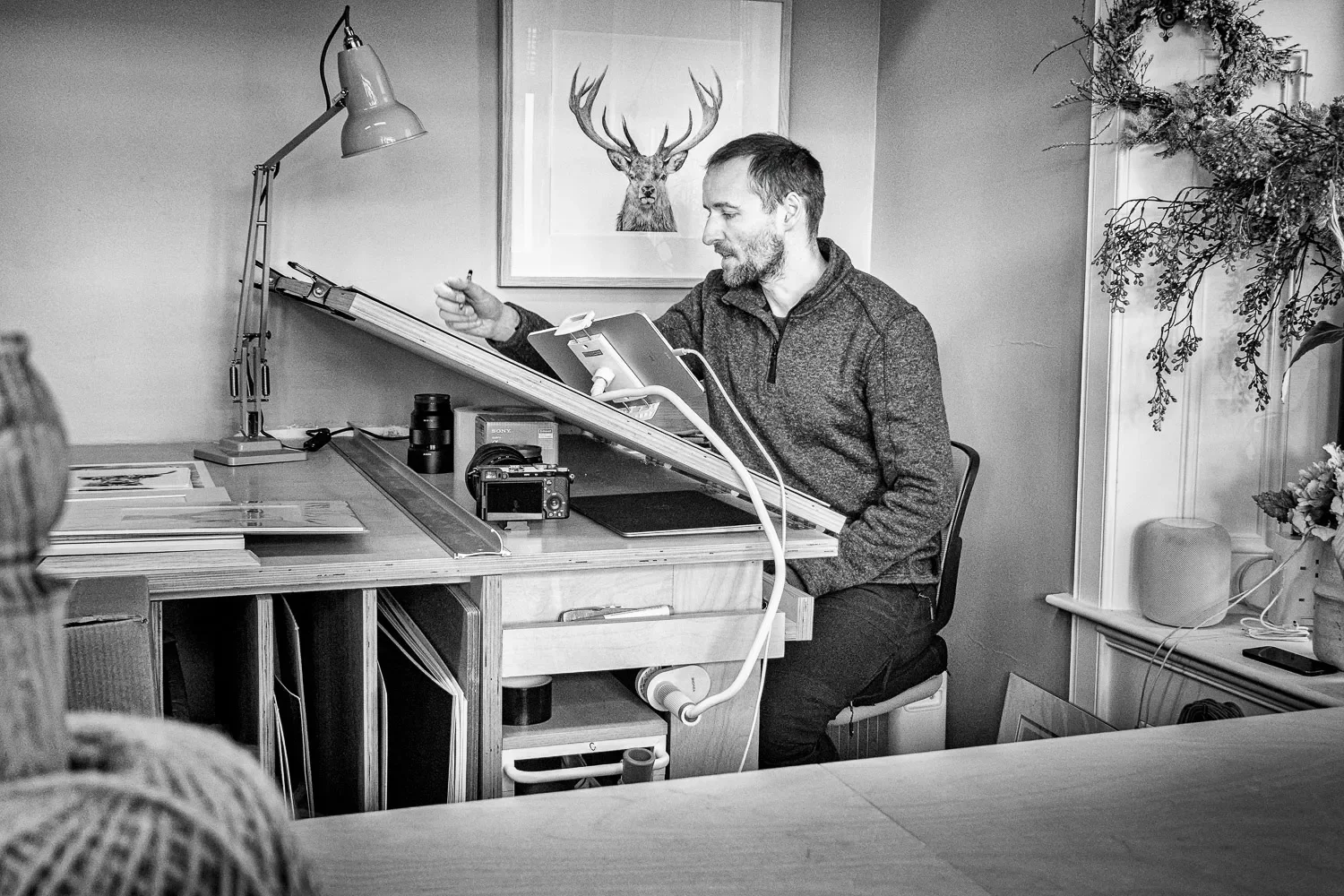
Stuart absorbed in work at his drawing board, the full studio visible around him. Drawing board, Anglepoise lamp, Sony camera, stag print, natural light from the side window. This is the shot that shows the whole picture – the person, the craft, the environment, and the brand, all in a single frame.
This one was instinctive, but there's a logic to it worth explaining.
Stuart's artwork is monochrome. Every piece he creates is pencil on white paper – no colour, no tone, just graphite and light. Converting the images to black and white wasn't just an aesthetic choice; it was a way of making the photography feel cohesive with the work it was documenting. The two disciplines, his drawings and my photographs, now share a visual language. The set feels unified in a way that colour simply wouldn't have achieved.
When you're shooting for a brand, that kind of thinking matters. The images shouldn't just look good in isolation. They should look right together, and they should look right alongside everything else the business produces.
A note on the images: all photographs were shot on location at SASCO Art, West Princes Street, Helensburgh, using natural light from the shop's large corner windows. Converted to black and white in post to complement Stuart's monochrome pencil artwork.
What this means for your business
If you're a creative, an artist, a designer, an entrepreneur, or a small business owner – anywhere in the UK, this kind of photography is one of the most valuable investments you can make in how your business presents itself.
It doesn't have to be a gallery in Scotland. It could be your studio, your workshop, your office, your shopfront, your market stall. Wherever you work, and whatever you make or do, there's a visual story to tell. My job is to find it, frame it, and give you a set of images that do the hard work of representing your business every time someone visits your website or scrolls past your social media.
The goal is always the same: images that feel true to who you are, and that make the right people want to work with you.
If that sounds like something your business needs, I'd love to hear from you.
“I had the pleasure of working with Mike for a recent photoshoot at my new art studio, and I couldn’t be happier with the results! He has a brilliant eye for composition and managed to capture the space and atmosphere perfectly.
Not only are the photos beautifully composed, but he was also great to work with – friendly, professional, and easy-going.
I’d highly recommend him to anyone looking for great photography and a smooth, enjoyable experience!”
Ready to tell your story? If you're a creative, designer, artist or entrepreneur looking for brand photography that goes beyond the headshot, let's talk. Get in touch or click the button below.